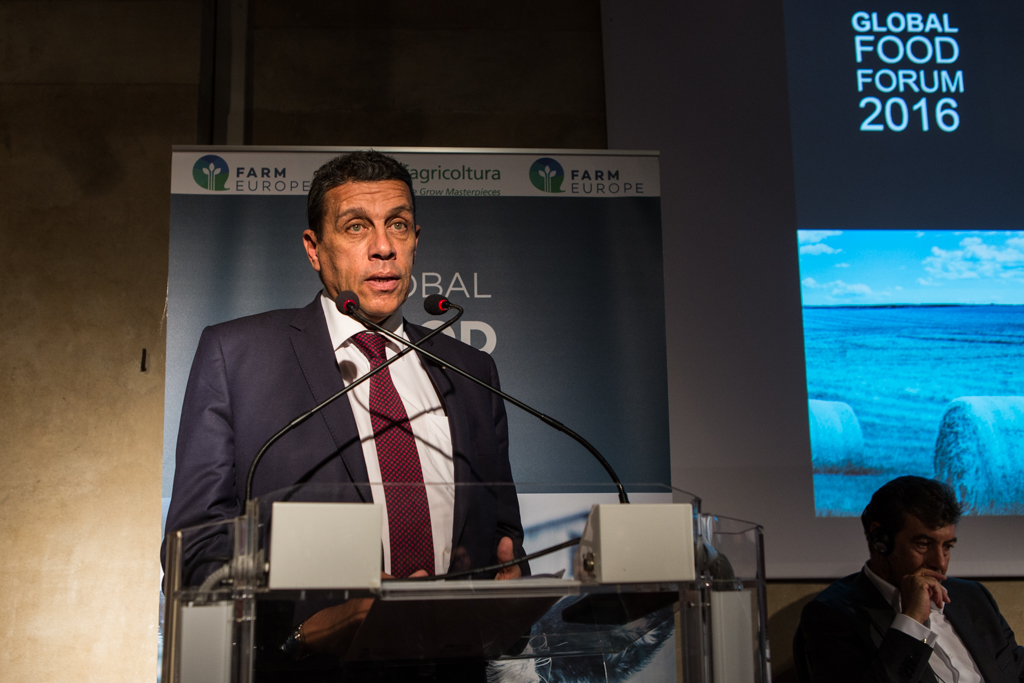
Today, Farm Europe presented the final report of the 2016 edition of the Global Food Forum to the EU institutions, in the context of the public consultation on the future of the Common Agricultural Policy (CAP) launched by the European Commission last week.
“Time has come to table a real economic strategy for EU agriculture and food systems. Sending a cheque when political pressure is too high to cope with volatile markets is not sustainable. We need to reflect seriously on the best ways to use public spending. In doing so we will restore confidence, regain optimism and build future growth. Agriculture needs visibility, predictability and transparency”, stated Mario Guidi, the President of the Global Food Forum and of Confagricoltura, presenting the report which includes a set of key priorities for the future CAP.
Opening the event, Phil Hogan, European Commissioner for Agriculture and Rural Development underlined that « Coming just the week after I launched a 12-week public consultation on the simplification and modernisation of the CAP, the presentation by Farm Europe of the recommendations are particularly timely. I am pleased, to see that, in the report, there is a clear acknowledgement of the need to “strengthen the resilience of our farms” and a particular focus on risk management tools. We must modernise the CAP, giving it a toolkit to react quickly and effectively in the event of future price shocks” (07_02_2017 Speech at FARM EUROPE Event New Ambition for CAP_3).
Hosting the event, Michel Dantin, Member of the European Parliament, insisted on the fact that « it is essential that the European Commission and the European Parliament work hand in hand in order to meet the challenged faced by our farmers in the short and medium term and to prepare the next CAP. I urge all the actors to pose strategic questions, without taboos: do we want the CAP to be an economic policy or only a social policy aimed at ensuring the livelihood of farmers and rural areas? Should we remain within the binding framework of the World Trade Organisation or free ourselves from it like all our international competitors?
Co-hosting the event, Giovanni La Via, Member of the European Parliament added: “Food security and climate change are the two main challenges to be faced by the humankind today. I believe that Agriculture and farmers are at the core of the answer we have to provide. I fully embrace the goal of double competitiveness of the European farms presented in the Forum’s report. After Paris, it is clear to me that we have to protect our environment, while at the same increasing European agricultural competitiveness. And we must be able to design simple and long -term policies focusing on results. We need a stronger and simplified CAP for the future, in line with the challenges ahead of us”.
The report presents a set of key actions to build a stronger EU agriculture, performing both economically and environmentally summarised as follow (the full report is available here : Excecutive Report GlobalFoodForum EN):
Delivering modern risk management tools with a first step in 2017
The new strategy for resilient agri-food systems in Europe should integrate one fact: more than ever, agriculture is facing growing climate and market disturbances. For the benefit of the whole EU food chain, the CAP should make available a set of efficient risk management tools to enhance the resilience of the wide range of EU agriculture models. This will not be obtained through a single instrument at European level, but through a choice of complementary tools, placing farmers at the core of the decisions according to their specific situation and needs. In each Member State, farmers should be free to opt for tailored self-insurances and/or mutual funds. In 2017, the EU co-legislators should seize the opportunity of the Omnibus regulation to step up these tools, making them much more attractive and efficient.
Finding a New deal across the food chain actors
The lack of cooperation within the EU food chain is undermining the capacity of the sector to cope with the challenges posed by globalisation and investment. The new deal should first reaffirm the prominence of the CAP over general competition rules. This principle should also be applied by national competition authorities. Transparency should be improved, including when it comes to prices and volumes at first processing level and final consumer level. Contractual relations should be encouraged on the basis of clearer rules, allowing collective contract negotiations at Producer Organisation level or by Groups of Producer Organisations. In order to encourage cooperation among farmers and food producers, a branch approach for volumes and price negotiation should be explicitly authorised to guarantee a better repartition of the value when prices are going both up or down. These approaches should be seen bearing in mind that the relevant markets for the main agricultural products are more often at European scale than national or regional. When it comes to Unfair Commercial Practices, a clear set of practices should be prohibited, with clear and dissuasive sanction mechanisms, fully securing the identity of the complainants.
Environmental sustainability: focusing on results
Technological advancements in the agricultural sector create new opportunities for environmental and sustainability policies at the European level. The EU institutions can seize the enormous potential of innovations to build simple and effective policies and reduce the amount of bureaucratic procedures for farmers. The European Union should consider a shift from a prescriptive policy to a real results-based policy that would be complementary with the current greening criteria and based on the will of farmers themselves. (Producers could opt for the existing policies or a results-based approach). Such a new option for the greening requirements would be based on quantifiable objectives that are adjusted to the knowledge and technical capacities of farmers. It would complement the current rules as an alternative option.
Economic sustainability: focusing on investments
The ambition of keeping a dynamic agri-food industry all across the EU should be transformed into reality. Over the past 10 years, the competitiveness of the EU agricultural sector decreased. The total EU farm productivity growth dropped by 54% and capital productivity turned negative. Europe must not limit its actions to a set of initiatives aiming at accompanying a slowing down of its farming sector. Neither should it accept to limit its ambition to an agriculture of conservation of the most fragile areas. On the contrary, the European policy framework should focus on launching dynamic and targeted economic strategies to revive investment all across the EU food chain. The economic dimension of the Common Agricultural Policy should be renewed.
Nutrition and health: strengthening trust
The European food chain is facing the challenge of finding a harmonious and positive relationship between diet and health. To do this, a number of obstacles must be overcome: a clear and joint strategy from all the actors of the food chain (agriculture, industry, trade) should be defined, the credibility of EFSA as a the pole of excellence and reference for EU legislators should be strengthened, the scientific consensus, as well as media and institutional communication should be improved to avoid confusion among consumers and law should be based on real and credible scientific evidence, not assumptions. In addition, dialogue with Civil Society should be encouraged in order to build a new consensus and go beyond ideological positions. The lack of debate between public and private actors around the issue of food and health is unacceptable. This challenge must be tackled seriously, at EU level in order to build trust among the actors and define a real European vision and solution.
Brexit and Trade: focusing on EU interests
Most of the EU countries have substantial trade interests in the UK market when it comes to the agri-food sector. Whatever the result of the EU/UK negotiations, both the internal policy shift in the UK and diverging trade strategies between the EU and UK will lead to medium and long term changes for the EU agri-food sector. This should not be underestimated now, even more following the clear commitment of the new British leaders to create “the biggest open economy in the world”. This strategy will make it difficult to achieve a full free trade agreement between the EU and the UK, without any safeguards. The common line for the challenges of Brexit and freer trade is enhanced competition for the EU-27 agri-food sector across the borders and a very daunting challenge notably to the beef sector. When it comes to the overall EU trade agenda, Brexit may be the occasion to review the way that mandates for negotiations are given to the European Commission, and to relaunch the EU trade policy on a new governance, more transparent and thus more acceptable to civil society.