NBTs: What are we talking about?

Today, Farm Europe organized and hosted a discussion on New Plant-Breeding Breeding Techniques. 

This event has been an opportunity to better understand the potential risks and benefits of the new plant breeding techniques, thanks to a direct discussion with well-known scientists. This debate’s aim was to shed light on the challenges in relation to the ongoing discussions around the future of plant improvements at European level and in EU Member States, in the context of the current regulatory framework.

Opening the debate, Farm Europe introduced the issue by specifying that today, the agri-food sectors are more than ever confronted with 3 major demands from our society: (1) to provide safe and quality food, (2) to keep rural areas lively and viable and (3) to optimize the good management of the environment and to fight more effectively against climate change. (A full briefing on NBTs is available here)

“Being able to answer jointly to these three challenges is for sure a challenge in itself, but a feasible one, if you accept to live in this Century, to make effective use of science and concentrate your efforts on double performance: economic performance and environmental performance” , Yves Madre stated.

Furthermore, he also underlined that “in an overall context of stagnation for EU agriculture, it is now time to reinvest in innovation and research, in genetics and to develop a concrete science-based approach in that respect”.

New breeding techniques are said to be promising as modern and faster extension of usual traditional breeding techniques. But if the aim is to develop sensible policies and orientations based on solid ground, the first question to be answered when it comes to NBTs is: What are we talking about? And precisely:

  • Scientifically, what are NBTs in simple words?
  • Economically, what are the expectations and what is already known?
  • On Environment, is there any added value?

Three high-level panelists addressed today’s issue from the scientific point of view: Dr. Eli Khayat researcher at Rahan Meristem, Professor Piero Morandini, researcher in Plant Physiology at the Department of Biology of the University of Milan and Dr. Emmanuel Guiderdoni, scientist working at the Biological Systems Department of CIRAD.

Professor Piero Morandini presented what NBTs are in relation to plant breeding, and more specifically CRISPR/Cas9 as “this technique is going to have the greatest impact on our society if we are wise enough” and it will be the most applied technique in the future. In this context, he underlined the implications to plant breeding and discussed the comparison with traditional techniques, also by giving an overview of the current regulatory framework in Europe. “With transgene-free genome-edited plant you can have the genetic change where you want and furthermore every gene conferring bad traits can be selectively knocked-out” he said.

Dr Eli Khayat, gave the perspective of a commercial breeding company. He focused on the NBTs innovations already available worldwide and on what can be expected next in terms of developments and their economic aspects. Specifically, he stressed that “not all NBTs are created equal” and that “some of them are detectable but this is not the case for all of them and so we should distinguish between different techniques according to this aspect”. Furthermore, he also stressed that “with these new techniques we have many possibilities to target genes. Of course, there are challenges in this technology but they can be easily overcome”.

 While Dr. Emmanuel Guiderdoni from CIRAD explained the impacts of NBTs from an environmental perspective, what can already be said and what can be expected. His current work focuses on the impact of these new technologies and on selecting traits which are of genetically importance. Specifically, he said that they are collaborating in breeding programs on rice, with the aim to reduce nitrogen in fields. “Crispr-Cas9 is a fantastic tool” he argued, “we can target specific improvements on a single trait”.

The three scientists agreed on one very straightforward concept: the use of some of these NBTs (notably the CRISPR-Cas9) can play a key role in allowing plant breeders to introduce in an efficient way, very precise, targeted genetic modifications, which have the capacity to fasten the selection speed.

 In other words, this translates into: low cost, ease of use and speed up of innovation processes, when compared with conventional plant-breeding techniques. Furthermore, NBTs are not only a valuable option for breeders, but these modern biotechnologies also allow to develop plant varieties that can adapt to climatic changing conditions and ensure high level of biodiversity.
Future CAP : Eastern and Central European Countries in the driving seat

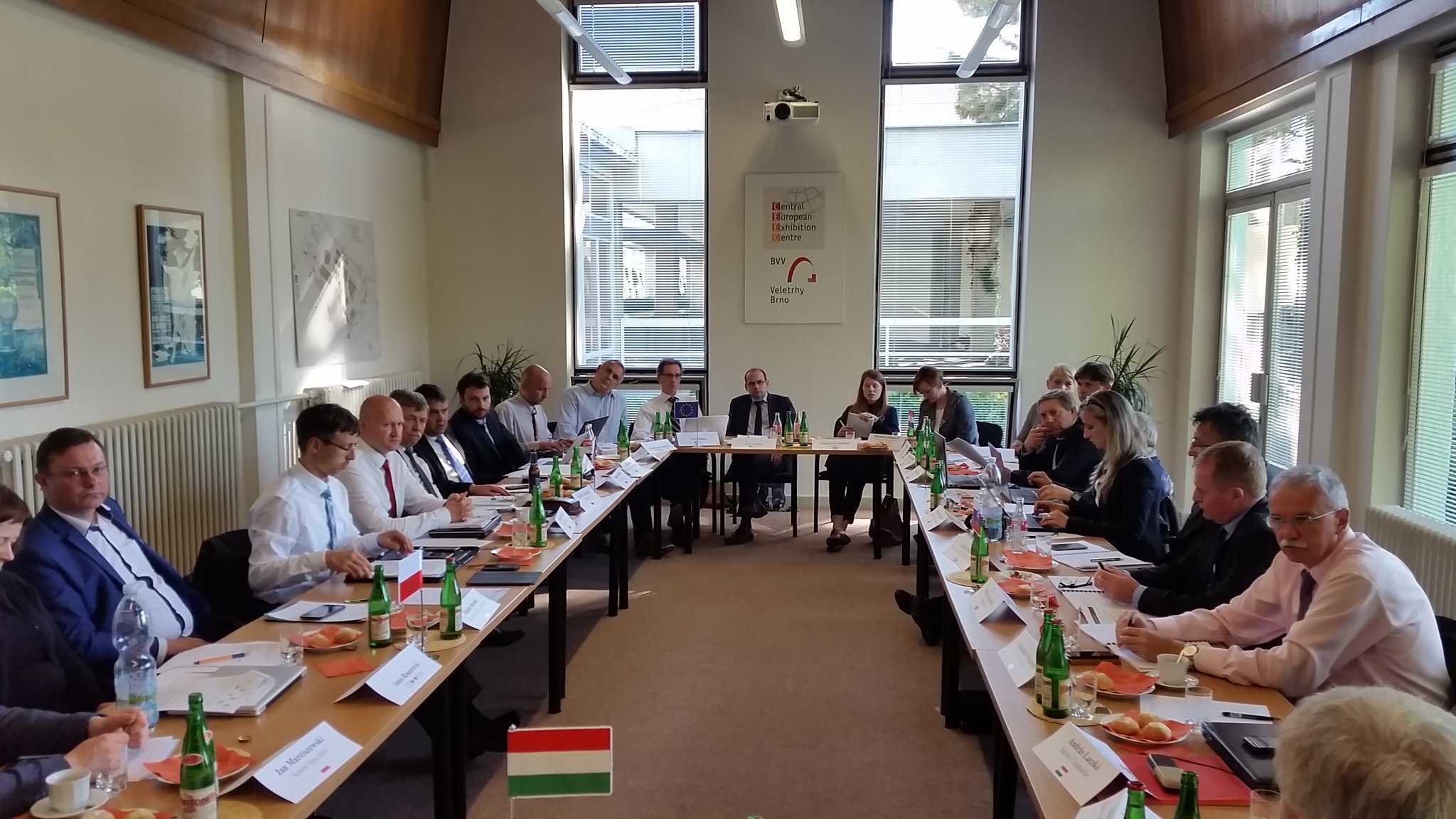
V4 Group PictureFarm Europe was delighted to take part and to contribute to the reflection of the 65th Meeting of the Representatives of Chambers of Agriculture of the Visegrad 4+ group (Czech Republic, Hungary, Poland, Slovakia, Slovenia, and Croatia).

These organisations adopted a first set of common position on the most pressing topics for the future of the Common Agriculture Policy, designing key orientations to enhance both the economic and the environmental sustainability of the European farming sector.

During this meeting, Yves Madre stated:

“Today marks the beginning of a very timely and necessary work.

As a former negotiator of the CAP, I definitely know how challenging it is.

I truly believe that the dialogue you established, as the Visegrad Group, is of paramount importance to build a strong clear and promising future for a truly Common Agricultural Policy.

To work ahead of the EU agenda, to be proactive and not reactive. To propose needed and feasible evolutions of EU policies and to pursue the necessary path towards a better future for the agricultural sectors all across the EU.

This overall ambitious strategy can only be built by working together for a shared, common project. With the current level of political uncertainty in most of EU Member states, not to mention the Brexit, it is of utmost importance for economic actors and their representative bodies, to be conscious and to realise what they want for the future, to define a strategy and even more to table concrete proposals.

This is exactly our ambition at Farm Europe, and thank you to AKCR for the truly appreciated invitation to be here with you today. Thank you for being such an involved and a valuable active partner as well.

A priority is to have Central and Eastern Member states in the driving seat of the future CAP.

As correctly underlined by the Bratislava Declaration you signed last month, the strategy to be promoted should be based on three main pillars Investments, Sustainability and Resilience.

Today, the challenge is not only to be in a position to articulate this vision, the related strategy and architecture of a renewed, more effective CAP before the start of negotiations on the next financial perspectives, thus before 2018. But as well to identify and select the right tools, which are needed to make this strategy work smoothly.

Investments: this is the challenge of the EU precision & smart farming sector, but in considering a short term vision and not a 20 years time frame. An array of competitive investments should be defined by each sector, considering both the economic and environmental benefits they can bring to the society.

Sustainability: building on this evolution path, switching from a prescriptive CAP to a results-based CAP, by defining what is expected from farmers and giving them freedom of action to deliver the expected, well defined and easily measurable goals.

Resilience: direct payments remain the first vital layer. Payments that are legitimate, needed and fair. In that respect, the economic dimension should be put ahead when it comes to EU tools. Key is to build on this first layer, by devising efficient tools to manage climate and markets volatility and to increase the potential of farming sector in the context of a food chain, whose relations are today very unbalanced.

These points have been partially addressed by the on-going negotiations on the Financial Omnibus, thanks to the right, productive approach of the European Parliament strongly supported by Farm Europe.

As a whole, in one word, the key aim today is to switch from a EU policy approach, which focuses only on conservation, to policies, which are conceived and able to promote entrepreneurial approaches, where farmers are at the core of the whole process, and notably the CAP, where sustainability has to be improved, thanks to better competitiveness and increased farm profitability.

The CAP should be what it was supposed to be since the beginning: a EU policy promoting investments. Investments of the EU in its economy, growth and jobs, investments of the EU in sustainability, and investments in its farming sector which is the only one able to achieve growth and provide jobs in rural areas and capable at the same time to fight against climate change effectively. This will happen only if the next CAP is reshaped on a solid basis. Its focus should be on the concept of double performance, economic and environmental, considering farmers as entrepreneurs while not forgetting the social and territorial dimension of agriculture.

It is our common responsibility to draw the renewed CAP we need, to propose the forward-looking vision and to table concrete tools to deliver in practice.  And, of course, to convince and inspire decision-makers to act in this regard.

Indeed, we have to act now. 2018 is tomorrow and the Council wants to define the main orientations of the next CAP, whenever this CAP will be reformed and implemented (2020 or 2022).

It’s in that respect that your work, our common work at EU level with inspiring meetings as today’s one, is a key stepping stone to shape and realise our progressive strategy.”

MEPs propose a more efficient CAP starting from 2018

Faced with a timid attitude adopted by the Ministers of Agriculture, MEPs took stock of their responsibilities and decided to make the most of the possibility offered by the “Omnibus” to propose common sense adjustments to the Common Agricultural Policy. The decisive approach suggested by the report of the European Parliament’s Committee on Agriculture and Rural Development (AGRI) would give farmers, by 2018, the means to be more resilient to crises and stronger within the food chain.

Without waiting for a reform of the CAP on the basis of the still uncertain agenda, the line proposed by the report, which was adopted on May 5 by the EP’s Committee on Agriculture, would enable the 2013 reform to be completed and simplified on two key aspects: Risk management tools and Competition law. The amendments, which have been negotiated mainly by three key actors of the 2013 reform – Albert Dess (Germany), Paolo de Castro (Italy) and Michel Dantin (France) – propose the following improvements:

– Facilitate the recognition of Producer Organizations by Member States; Strengthen their role in processing, sale, transport or packaging; Enable these organisations to manage volumes among them, as well as the marketing and negotiation of contracts and the related conditions on behalf of their members: these are some of the initiatives they are requesting specifically for the “food chain”.

– In addition, they proposed not only, to reinforce the risk management component of the CAP by lowering the triggering threshold for crop or climate insurance to 20%, but also to enhance improvements in income stabilization tools. It is specified that this tool must become sectoral, should be triggered after 20% of losses, and should be able to be supported by the CAP when farmers and/or all the actors in the supply chain contribute to them, and not only in the event of a crisis.

These proposals give the possibility to enrich the range of CAP tools, while leaving Member States and farmers freedom of choice. It is now necessary that the European Parliament validates these proposals as a whole and then that it needs to ensure that they will be widely taken up during the trilogue negotiations also by the co-legislator and the Commission.