After the wine, a high-level group on sustainable livestock is needed

The recommendations adopted earlier this week by the EU High-Level Group on Wine highlight the tangible benefits of a multi-stakeholder approach, as emphasized by Farm Europe at the outset of this process. Bringing together diverse actors across the value chain, with a clear vision and a concrete strategy, is crucial for supporting the economic sustainability of strategic sectors in the EU and for charting a path forward.
A thorough understanding of the sector’s challenges — whether structural, climatic, or shaped by citizen expectations — is essential to developing effective policy recommendations and legislative proposals.
This significant outcome, along with the renewed approach, should serve as a guiding framework for the livestock sector as well, event if the challenges and solutions will be different.
Given the positive, concrete results from the HLG on Wine, along with the European Parliament’s political commitment to fostering a transparent, non-ideological debate on the livestock sector — exemplified by the establishment of the EP’s dedicated Intergroup — Farm Europe and Eat Europe believe it is time for the European Commission to launch a similar process for this sector.

As Farm Europe’s research shows, the livestock sector is at a critical crossroads. To address its challenges, we must take a scientific and evidence-based approach, focusing on both its economic sustainability and the public discourse surrounding it. This includes presenting, in an objective manner, not only the environmental challenges, but also the positive contributions of the sector:

  • Its role in the bio-circular economy, soil quality: manure and by-products produced by a cow are transformed into a positive and virtuous bioeconomy model as energy (biogas, biomethane, biodiesel), or as organic fertilizer (digestate, RENURE). Eighty percent of the water used in a cow’s production cycle is returned to the land, improving soil quality by enriching it with organic matter, just to give some examples;
  • The vitality of the countryside and remote areas, which, without a solid and profitable livestock sector, would be abandoned with dramatic consequences on the environment (erosion, fertility of soils, etc.) and the economy of those regions;
  • The production of high-quality, nutritious food, essential for balanced diets.

It is time for Europe to boost its animal sector to grasp its full potential, rejecting strategies that would lead to the sector being replaced by lower-quality imported proteins or by lab-grown proteins disconnected from natural cycles. The finalisation of the EU/Mercosur deal generates doubts about the double-standard approach by the European Commission.

At a time when producers are grappling with significant challenges, it is crucial to develop a renewed, shared agenda for the sector that is supported by all levels of government, from the EU to local authorities. The EU’s livestock model must remain economically viable while adapting to increasing societal and environmental demands. Key issues — such as health, biodiversity, climate and environmental impacts, economic potential, and the social fabric tied to livestock activities — must be addressed in a cohesive and integrated manner.

These elements should be fully incorporated into the European strategy to ensure a sustainable future for Europe, starting with the establishment of a dedicated High-Level Expert Group.

State aid to agriculture: more than €18 Bn since 2021

As part of its considerations on the CAP and crisis management, Farm Europe analysed the State aid granted to the agricultural sector since the start of the budgetary period.

Between 2021 and 2024, Member States allocated over €18 billion in State aid to the agricultural sector, representing no less than 11% of the  total aid under the first pillar of the CAP — a proportion that rises to 14% when focusing solely on the 2021-2023 period.

The volumes of aid granted vary considerably between Member States, revealing a ‘three-speed Europe’.

The Netherlands has by far provided the most support to its agricultural sector, both in absolute terms and relative to direct payments or the national agricultural production value. Over the period studied, aid accounted for 101% of the first pillar received by Dutch farmers, totalling almost €3 billion. Denmark, Greece, Hungary, the Czech Republic and Slovakia also granted substantial funds, ranging from 20% to 43% of their respective direct aid. During the 2021-2022 period, Spain distributed the equivalent of 28% of its first pillar. Finally, while the total amounts provided by Italy, France and Germany remain substantial, these States have limited their support to between 5% and 10% of their respective direct aid, a level below the European average.

On average across Europe, these State aids only partially compensated (70%) for the loss in the real value of CAP first pillar payments resulting from their lack of indexation to inflation. The situation, however, varies significantly from one Member State to another.

  • Four countries overcompensated for the decline, providing farmers with liquidity that could boost their investment capacity. The Netherlands stands out in particular, with support 8 times greater than the inflation-related decline. Poland and Spain (1.4 times), and Greece (1.3 times) follow.
  • The other countries that provided the most support for their agriculture offset the decline by between 50% and 75%.
  • Finally, it should be noted that some countries granted very little state aid to their agricultural sectors (e.g. Latvia, Estonia, Ireland, Romania, Belgium, Luxembourg, Bulgaria and Portugal).

In the “Our work” section, you will find a more detailed analysis of the subject, as well as an infographic showing the situation in each of the countries of the European Union, over the period and by year. 

EU / Ukraine: analysis of the main agricultural crop sectors

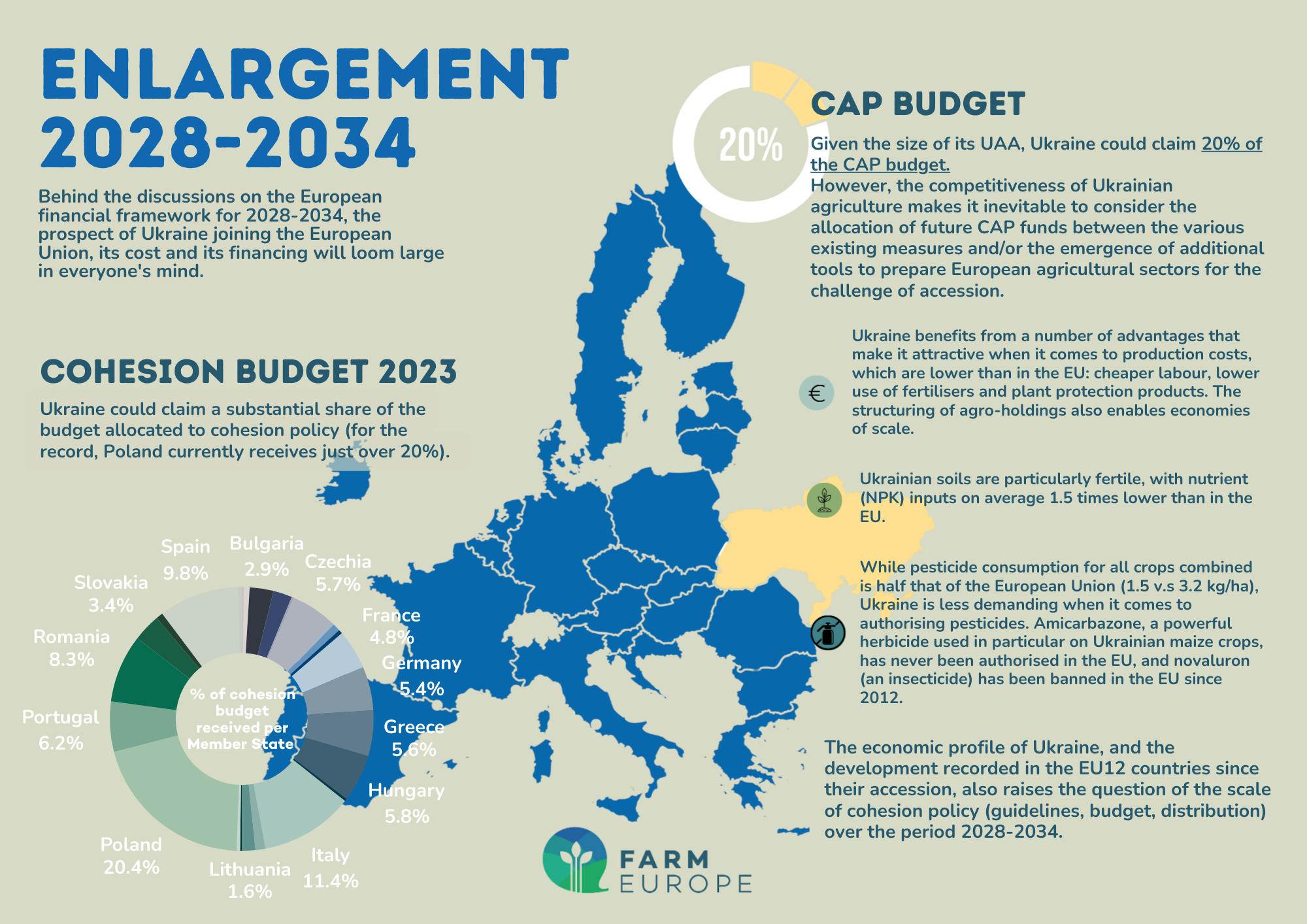
As part of the process of enlarging the European Union to include Ukraine, Farm Europe has analysed both the weight and comparative competitiveness of Ukraine’s main crop sectors compared to those of the European Union. 

The difference in competitiveness ranges from 19% to 39% depending on the sector, with structural factors accounting for most of the difference. To this must be added the ‘carbon’ competitiveness conferred by the natural richness of Ukraine’s soils. 

At a time when the steps and conditions of accession are about to be drawn up and the pre-accession programmes defined and launched, we feel it is important that objective data can serve as a basis to define the European Union’s roadmap, without bias or avoidance.

Ukraine & European Union: key figures for the main agricultural crops 

In 2022, Ukraine’s utilised agricultural area covered 41.3 million hectares, including 32.7 million hectares of arable land (State Statistics Service of Ukraine (SSSU)). This agricultural area makes Ukraine the largest agricultural country on the European continent. 45% of the country’s surface area is made up of humus-rich, particularly fertile soils known as ‘rich’ chernozems.


Marked by its communist past, the Ukrainian agricultural sector is characterised by 110 huge vertically integrated agricultural companies, known as agro-holdings, which control all or part of the production chain (crop-livestock, processing, trade). These entities aim to maximize returns on invested capital, investing heavily in cutting-edge, large-scale equipment and the use of inputs. Twenty of these companies are estimated to control 14% of Ukraine’s Utilised Agricultural Area (UAA), and 57% of the UAA is farmed by enterprises of more than 1,000 ha. Agriculture plays a major economic role in the country, accounting for 10.9% of GDP in 2021 and almost 14.7% of employment.

Sugar

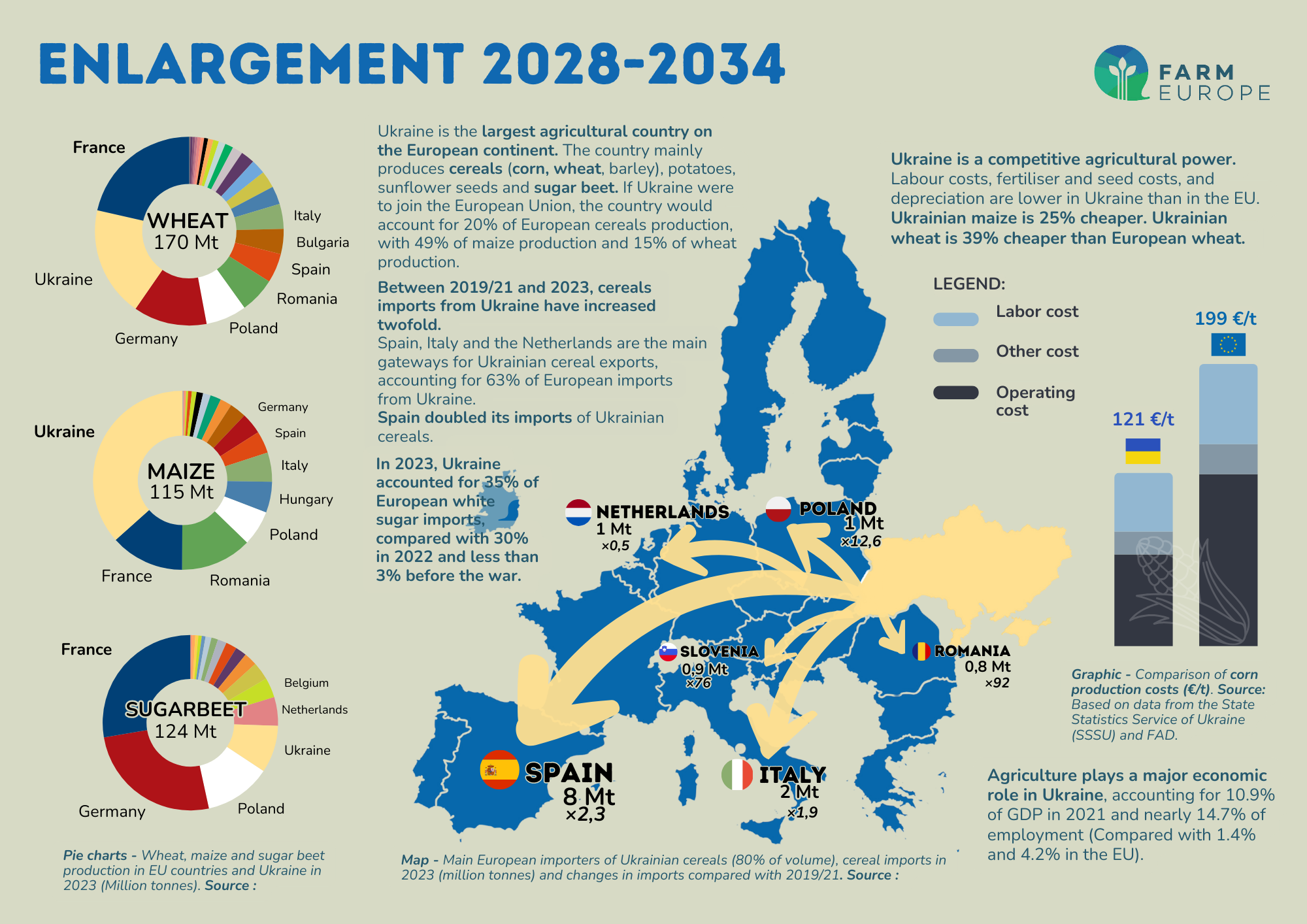
The organisation and competitiveness of the Ukrainian sugar sector is very different from that in Europe: agro-holdings, huge vertically integrated farms, cultivate 93% of the sugar beet area. The average cultivated area is 23,700 ha, 1,763 times more than in the European Union. 

Ukraine has much lower labour and investment costs. What’s more, the presence of fertile soils means that fewer inputs are used on crops: up to 1.5 times less fertiliser than in the European Union

The opening up of the European market to Ukraine has resulted in an influx of sugar, which has led to an increase in European stocks. Exports of sugar from Ukraine to Europe have increased by 230% between 2022 and 2023, with a forecast export capacity to the EU of 800,000 tonnes to 1 MT. The introduction of safeguard measures now limits exports for the time they are in force. 

Detailed analysis for the sugar sector

Cereals

Cereal production is not as dominated by large farming structures as the sugar sector: 51% of production is carried out by structures of less than 1,000 ha. It should be noted, however, that 22% of production is carried out by companies with more than 3,000 ha

If Ukraine were to join the European Union, the country would account for 20% of European cereals production, with 49% of maize production and 15% of wheat production. 

Ukrainian cereal production costs are on average 30% lower than those in Europe. 

For these reasons, grain imports from Ukraine have doubled between 2019/21 and 2023. The European Union has become a pillar of support for the Ukrainian economy, accounting for 51% of wheat exports in 2023, compared to 30% in 2021.

Detailed analysis for the cereal sector

Sunflower

While 58% of production is carried out by structures of less than 1,000 ha, companies with more than 3,000 ha account for 17% of production. In 2023, Ukrainian production alone was greater than the entire EU’s production. As such, if Ukraine were to join the European Union, the country would become Europe’s leading producer of sunflower seeds, as well as sunflower oil. 

Ukraine has been the EU’s leading supplier of sunflower oil for around ten years now. The opening up of the European market to Ukraine has had no significant impact on the flow of sunflower oil from the country.

Detailed analysis for the sunflower sector

Rapeseed

Farms of less than 1,000 ha account for 73% of rapeseed production, but oil production is dominated by 5 companies which accounted for 92% in 2021.

In 2020, the cost of rapeseed production in Ukraine was, on average, 1.5 times lower than in France.

Compared to the 2018-2021 average, Ukrainian production of rapeseed and rapeseed oil has risen by 57% and 174% respectively. Similarly, exports grew by 37% and 170% respectively. If Ukraine were to join the European Union, it would become the leading rapeseed producer in the EU, accounting for 24% of seed production and 4% of oil and meal production.

The EU was already the largest importer of Ukrainian rapeseed products before the war.

However,  imports of rapeseed have increased, and the EU now receives 93% of Ukraine’s rapeseed exports, compared to 83% in 2020/21.

Detailed analysis for the rapeseed sector

(Click on the image to enlarge it)

WHAT IS NEW IN THE LATEST TEXT OF THE EU-MERCOSUR AGREEMENT

The Commission has reached a revised EU-Mercosur Agreement in December 2024, which presents some changes regarding the previous 2019 Agreement.

The Paris Agreement on Climate Change is now included. It will allow the suspension of the agreement if a country leaves the Paris Agreement and also if it stops being a party “in good faith”.

But what are the obligations of developing countries, like those in the Mercosur, under the Paris Agreement?

  • Adaptation planning: developing countries must engage in adaptation planning processes and implement actions to build resilience to climate change. This includes: assessing climate change impacts and vulnerability; formulating prioritized actions; monitoring, evaluating, and learning from adaptation plans and actions.
  • Developing countries must also prepare, communicate, and maintain Nationally Determined Contributions (NDCs), which are their post-2020 climate actions. NDCs include actions to reduce greenhouse gas emissions and build resilience to climate change. 
  • Developing countries must regularly report on their emissions and progress in implementing their NDCs. 

None of these obligations comprises any specific or quantified targets. In addition to that, the Paris Agreement does not provide for any sanctions in case of non-respect. There are no GHG reduction commitments to respect, or any other quantified commitments.

Therefore, if Mercosur countries do not walk out of the Paris Agreement or stop preparing NDCs, there are no foreseeable consequences of its inclusion in the EU-Mercosur Agreement. 

A new Annex to the Trade and Sustainable Development (TSD) Chapter has been negotiated, which will have the same legally binding nature as the TSD Chapter itself. A key feature of the Annex are new commitments on deforestation: “Each Party reaffirms its relevant international commitments and shall implement measures, in accordance with its national laws and regulations, to prevent further deforestation and enhance efforts to stabilize or increase forest cover from 2030”. But the Annex also states: “They further acknowledge that their policies must take into account the social and economic challenges of developing countries and their contribution to global food security”. “They also stress the need for enhanced support and investment to achieve these objectives, including through financial resources, technology transfer, capacity-building, and other mechanisms foreseen in this Agreement”.

From the above text it is far from clear whether, if a party like Brazil does not achieve stopping deforestation from 2030, whilst having implemented measures to that effect, that party infringes the Agreement. Moreover, could not that party claim that she did not receive enhanced support from the EU, including financial support, to reach those objectives?

The precise nature of the commitment to stop deforestation from 2030, whether it is actually effective, is far from clear. In addition, a reference is added to the EU regulation on deforestation (EUDR), undelining that “the EU recognises that this Agreement and actions taken to implement commitments thereunder shall be favourably considered, among other criteria, in the risk classification of countries“. This point must not justify lowering the EUDR risk category of Brazil or other Mercosur countries because of the Agreement, neither biais in the fact basis assessment expected by the European Commission when classifying risks . 

On the Tariff liberalisation schedule there are a few changes on trade concessions and safeguards for cars, but what strikes the most are the additional concessions on agriculture to the benefit of Paraguay: an additional quota of 1500 tonnes of pork, and an additional quota of 50 000 tonnes of biodiesel.

On export duties for raw materials and on Government procurement there are a few changes and concessions.

But there is a new and potentially more significant rebalancing mechanism in the Agreement. If a party considers that a measure of the other party nullifies or substantially impairs its benefits under the agreement, it can ask a panel to rule on this question. The rebalancing mechanism concerns trade effects of measures that the complainant could not have expected when the deal was closed. This new rebalancing mechanism could for instance concern the application of the Carbon Border Adjustment Mechanism (CBAM) by the EU. As the CBAM taxes would only be applied from 2026, it looks likely that the Mercosur countries could bring the EU to a bilateral dispute panel with a view to withdrawing concessions under the EU-Mercosur Agreement, or asking for compensation, in the event the CBAM taxes their exports.

To summarize, the 2024 modifications to the EU-Mercosur Agreement seems to trade mostly declaratory commitments from Mercosur on climate change and deforestation, for the possibility for Mercosur to seek rebalancing concessions if the EU applies new measures with trade effects like the CBAM; and adds some concessions on agriculture (pork, biodiesel) in favour of Mercosur.

The EU seems to have paid a price to conclude the deal, as it was visibly the most adamant and demanding party in the negotiations.