New Breeding Techniques: a new regulatory framework is needed


Persistent concerns but mainly doubts over what the ECJ ruling on NBTs actually means in concrete terms for Member States, are far from being exhausted. At the same time, many research projects of gene-editing adoption in both crops and farm-animals are taking place on both sides of the ocean.

A recent study requested by the European Parliament highlighted the potential of CRISPR-Cas9 approach as being “a substantial contribution towards a better targeting application and reduction of herbicides, fungicides and insecticides”.

News from abroad: new genome-editing technique discoveries which go beyond established methods and target commercial crops varieties show the first promising results.

Finally, few weeks ago, EU Health Commissioner Andriukaitis stated once again his opinion on New Plant Breeding Techniques, which, he said “need a new regulatory framework that takes into account the latest advanced technologies”.A similar reaction also from the EP side by MEP Paolo De Castro, who declared that genome editing is going to be “high” on next Parliament agenda.


full note available on FE members area 

Risk and crisis management tools: a new agri reserve endorsed by the ComAgri


The Member of the Agricultural Committee voted on April 8ththe Horizontal Regulation which is the cornerstone of the reform package of the Common Agricultural Policy (CAP) proposed by the Commission.

The concept of a new agricultural reserve, well-funded and more reactive, has been endorsed by the EP Committee by a wide majority. Such a crisis reserve financed with up to 1,5 billon EUR would allow the CAP to cope with major crisis and would help in developing stronger and more targeted risk management tools across Europe. This crisis reserve would aim at triggering market measures in case of serious market disturbances. Furthermore, it would work as a re-insurance for the Income Stabilisation Tool to be developed by farmers in the future with support available from the CAP 2nd pillar.
The reserve should be financed in addition to direct payments from the CAP and rural development funding. Its initial budget should be 400 million euros, while other funds could be added each year as well as unused funds from previous years, up to 1.5 billion euros. If this were not enough, the mechanism of financial discipline should be activated, but only as a last resort and excluding the first 2000 euros of payments.


full note available on FE members area 

Options to avoid a brutal crisis in the event of a no-deal Brexit

Brussels, 6thFebruary 2019


As the Brexit date of 29thMarch is fast approaching without a clear prospect of an orderly exit deal, the worst case scenario of a no-deal Brexit is becoming ever more likely.

Although an agreement is still possible and highly desirable, the political stalemate around the apparently intractable issue of the “backstop”, to guarantee that no hard border comes back to the island of Ireland, increases the probability of a no-deal.

We have said it time and time again, a no-deal means disaster for the UK and for the EU agri-food sector as well. We have consistently warned our Members and readers that a no-deal hard Brexit was a distinct possibility to reckon with.

Reverting on the 30thMarch to applying the WTO tariffs to the trade between the EU27 and the UK would disrupt the current trade flows on a number of key sectors and send shock-waves across the farming communities and the food sector in the EU.

High tariff barriers would be put in place along new burdensome procedures at the borders, which would worsen the impact on trade.

The brutal disruption of trade flows would also affect other economic sectors, as the integration of production systems in many industrial areas, including in pharmaceuticals, is high across the Channel.

The EU and the UK face shortages of key products, including food, medicines and industrial goods.

Rather than contemplating with horror what would happen, we have better work-out what options remain open in the event a no-deal hard Brexit becomes the new reality.

The first option is to reduce key tariffs to zero to keep the trade flowing. This could be done by temporarily suspending existing tariffs for all WTO members, including of course the UK.

This is however not an option that would preserve our agri-food sector from a brutal crisis. To keep trade flows from the UK open, we would sacrifice our sector to imports from other origins without any reciprocity. This would just replace a big problem by an even bigger one.

There is however another option, that would maintain the status-quo with the UK for a period of time long enough to enable new mutually beneficial relations to be agreed.

The disruption of trade flows would put at risk the availability of food, medicines and other products essential to the economy and for the well-being of the citizens. It would beyond reasonable doubt create a situation of emergency that should be avoided at any cost. It would challenge for a period of time the security of the countries affected.

Under WTO rules it is possible to evoke GATT Art XXI, which allows a country to “…taking any action which it considers necessary for the protection of its essential security interests” “… taken in time of waror other emergency in international relations”.

Art XXI could therefore be used for a limited period of time to keep existing trade flows till an agreement is found on the future EU-UK relationship. It would not reduce or impair the existing terms of trade with all the other members of WTO. It would not raise tariff protections, it would not impose bans on trade with other countries. It would only, for a limited period of time, maintain the existing terms of trade between the EU and the UK.

During this period of time the EU and the UK would keep its customs union untouched, which means by the way that the UK could not have the freedom to apply trade deals with other countries.

Recently Art XXI has been evoked by the US to protect its steel and aluminum industries, by the UAE to block trade with Qatar, and Qatar with the UAE. These situations hardly match the real emergency the EU and the UK would face in the event of a no-deal hard Brexit.

In the past, Art XXI was also evoked by the US on imposing a secondary embargo on Cuba, and an embargo on Nicaragua. The EU has used it during the Falkland war to impose an embargo on Argentina.

In addition to evoking Art XXI, both the EU and the UK should agree on a standstill that would keep all the existing regulations, standards, and other procedures under the Single Market, till an agreement on the future relationship is found.

The stakes are too high to accept failure for lack of action, where previously lack of political agreement brought the UK and the EU to the brink of disaster, in particular in the agri-food sector.

Whilst we have strongly supported the Withdrawal and Transitional Agreements, and we would have hoped for its approval by the UK Parliament, we cannot resign ourselves to accepting a brutal crisis in the event of a no-deal when there are good options available to stave it off, and create the time and the space for a better outcome.

UTPs DIRECTIVE: EU INSTITUTIONS REACHED AN AGREEMENT TO PROTECT ACTORS OF THE FOOD SUPPLY CHAIN

At the end of a sixth and final trilogue procedure, the European Parliament and the Council, on December the 19th,reached an agreement on the Directive to combat Unfair Trade Practices in the agri and food supply chain. This is excellent news for all producers and companies in the sector, who have been waiting for a European regulation for more than 15 years, while many self-regulatory initiatives have so far failed to put an end to unfair practices.The news is all the better as the scope and the number of practices, very limited in the original Commission proposal, were extended during the discussions.

The agreement reached today will apply to any actor involved in the food supply chain with a turnover of up to 350 million euros – seven times the threshold originally proposed by the Commission – and differentiated levels of protection are provided below this threshold. The European Parliament’s desire to expand to all companies has not been retained. The new rules will apply to retailers, food processors, wholesalers, cooperatives or producer organizations, or a single producer who engages in any of the unfair trade practices identified.

Prohibited UTPs were initially limited to perishable products only (payment after 60 days). They have been extended to cover: late payments for perishable food products (payment after 30 days), cancellations of last-minute orders, unilateral or retroactive contract amendments, forcing the supplier to pay for wasted products and refusal of written contracts. Other practices will only be permitted if they are subject to a clear and unambiguous prior agreement: a buyer returning unsold food products to a supplier, a buyer charging a supplier to secure or maintain a food supply agreement, a paying provider for a promotional, advertising or marketing campaign of a buyer.

Member States will be able to extend the scope of the Directive into national legislation, in particular by adoptinga threshold of more than EUR 350 million, or take additional measures if they so wish. “This is a minimum harmonization, therefore the member states can, or should in my eyes go further to strengthen the device provided by this directive” Parliament’s rapporteur Paolo De Castro noted following the agreement.It will be up to them to designate the authorities responsible for enforcing the new rules, including the ability to impose fines and initiate investigations on the basis of complaints. Confidentiality may be requested by the parties filing a complaint to address concerns about possible retaliation.

The Commission will put in place a coordination mechanism between the supervisory authorities to enable the exchange of good practice.

The agreement also includes a review clause set at 4 years, which means that the provisions of the law will have to be evaluated and possibly revised during the next parliamentary term.

It must now be formally approved by Member States in the Special Committee on Agriculture, be submitted then to the plenary and once approved by the Parliament, it will have to be endorsed by the Council and finally transposed into national legislation.

A NEW US FARM BILL IN SHARP CONTRAST WITH THE NEW CAP PROPOSALS

The US Congress adopted a new 5-year Farm Bill that enhances the commodity programs and crop insurance tools previously available to US farmers, in a sharp contrast to the European Commission CAP proposals that drastically cut the budget and support to EU farmers.

The new US Farm Bill increases support across the board. It increases most loan rates for commodities like cereals (wheat, maize, rice, etc), oilseeds (soybeans), cotton, sugar and others like peas and lentils.  It opens up the possibility to increase the reference prices for the insurance program Price Loss Coverage and improves the Agriculture Risk Coverage calculated yields.

Last but not least it boosts the dairy revenue insurance by sharply reducing the premiums for the smallest producers – below on average 240 cows, yes 240 this is not an error, this reflects the size of dairy holdings in the US- and increasing the level of protection for all farmers amongst other improvements.

The new Farm Bill also increases resources for environmental protection, and for export promotion programs.

Thus, the number one competitor of EU farmers gets a significant boost from the State budget the moment when EU farmers face the opposite – a reduction of 12% in real terms of the CAP budget proposed by the Commission.

Two sides of the Atlantic, two different tales. The US Farm Bill is built around tools that do not fit the EU model and needs, but it is striking that the US increases support when the European Commission proposes sharp cuts even when the sector faces stagnant incomes and dire prospects for the future.

The US farmers will have an even more robust set of tools to improve their resilience to market shocks and climatic events, whilst the EU farmers who have little of it would in the future have even less according to Commission’s proposals.

The EU model has done away with countercyclical payments that compensate farmers when prices drop, which led in the past to waste and alienated the sector from market signals and export markets, which concentrates public support in most productive areas and farms, and it should not emulate the US model in that respect.

But the CAP has not provided sufficient resilience tools to absorb climatic and market shocks. We need more climatic and income insurance and mutual funds, we need a real and well-funded crisis management fund – but that will not happen without CAP support.

We also need to do more to protect at the same time the environment and to improve the economy of the sector, which suffers from lower to negative productivity, compromising the future of farmers incomes and the sustainability of the sector. That will not come either without well targeted CAP support on double performance investments.

Will this new US Farm Bill make the European Commission re-adjust its CAP proposals and funding? If not the current Commission, the next? Will it ring alarm bells in capitals all too willing to let farm support go down? Will it energize the European Parliament to raise in defense of the EU agriculture sector?

We can only hope so. Otherwise our future seems more compromised.

Digital Agriculture Platform

Digital Agriculture Platform

To accelerate the digitization of agricultural sectors: to know and make known

What – Context & Overview

The main challenges for the European agricultural sectors and the related public policies can be summarized as follow:

– Accompanying the transition of European agriculture and rural areas to meet the economic, environmental and climate challenges the European Union is facing, and

– responding to the imperatives of food safety & sovereignty.

In this context, the environmental and economic performance of agricultural sectors are two sides of the same coin. Greater environmental performance cannot be achieved if the competitiveness of Europe’s agricultural sectors declines. Increasing sustainability requires more profitable economic sectors, able to invest in environmental actions, to bear the cost while earning a living in today’s open world.

Therefore, it is time to think of a “new agriculture” which considers the past, its mistakes and its achievements. A considerable body of agronomic knowledge and innovations in digital can be mobilized to work for the economic and environmental performance of farms, and to the benefit of citizens, farmers and consumers.

At the same time, large scale adoption of smart farming is a catalyst for the convergence of all EU agricultures, allowing for farmers that lag behind in terms of competitiveness to catch up at a very rapid pace with their more advanced colleagues, thus allowing for a fair development of EU agriculture as a whole.

To ensure the full success of such a digital evolution, we should:

demonstrate to both policy makers and economic actors the reality of this evolution, in other words assessing and highlighting the concrete economic and environmental contributions it generates;

convince that encouraging this transition is more effective than reflecting on future actions by thinking only at the past;

provide as many farmers as possible with access to these tools.

Encouraging agricultural value chains to make innovation on farms and to invest substantially in technical tools of dual performance, this requires not only convinced farmers, but also adequate political support and, at European level, a complementary mobilization of the European policies, with the aim to encourage these types of investments and to provide a favorable economic environment in highly volatile markets.

In that context and as time is pressing to demonstrate the importance for decision makers and stakeholders to get fully involved in the transition of the EU agricultures to agricultures of dual performance, it seemed appropriate the set up within Farm Europe of a Digital Agriculture Platform bringing together players from the agricultural and digital sectors who share a common vision of a digitization of the agricultural sectors in Europe which is: inclusive, centered around the needs of farmers, and in constant interaction with them.

Why – Aim, Vision

This platform aims to bring together agricultural sectors and operators sharing both the need to make the digital shift and lead this change to meet the needs of farmers, and in full interaction with them.

The Digital Agriculture Platform is about sharing experiences and highlighting the benefits of this change. Today, experiments & pilot activities are being conducted in different sectors, without bringing together the relevant common elements, and therefore allowing to give form to the positive intentions of policy makers in favor of the uptake of innovative and digital models.

Such an approach may be of particular interest as the economic and political challenge of dual performance is already part of the EU policy environment.

At the core of the Digital Agriculture Platform there is the aim to make the digitization of agriculture the political priority for the months and years to come.

1) Digital Transformation of EU agriculture: a “new agriculture” needed to tackle the pressing economic, environmental & climatic challenges & allow for the convergence of all EU agricultures;

Smart farming is a farming management concept which exploits digital technology means to monitor farming resources and optimize the application of agricultural inputs and practices in the farming process.

(Key words: paradigm shift, new agriculture, double performance, convergence)

2) Smart Farming: a valid solution for all farmers, all sectors & all types of farming across the EU as from today and not in a distant future;

Smart farming refers to a decision-making process that is not defined but can be optimized by the use of technology – namely by the combined use of data & knowledge coming from different devices & sources.
This process heavily involves the human factor: the farmer is placed at the center, being facilitated and accompanied all along the way by advisors who act as innovation brokers connecting him/her with an ecosystem of devices producing data and experts, generating, sharing and using knowledge.

(Key words: needs-based business models, low barriers to entry)

3) Promoting Smart Farming approaches that are holistic, inclusive & human- centered and allow for the development of a new culture of agricultural entrepreneurship based on informed decisions;

Smart Farming not only produces data, it equally generates a new culture of entrepreneurship: the farmer is not a passive consumer of expensive inputs that produces cheap products. He can make informed choices and business decisions based on the knowledge input: that is on data, scientific advice and market information.

(Key words: decision making process, ecosystem of devices & experts, knowledge input, new culture of agricultural entrepreneurship)

How – Work Programme & Activities

As a body of the think tank Farm Europe, the Digital Agriculture Platform offers the opportunity to reflect upon and to strengthen the means of action offered to its members on digitisation of EU farming sectors as well as on issues which go beyond or are interlinked. It provides a rich environment generated by members of varied backgrounds, all driven by a shared desire to better integrate competitiveness and environment as true principles of sustainable development.

The Digital Agriculture Platform is a place to build recommendations and proposals for policy-makers, with the objective of achieving a strong European vision for the agricultural sectors, of offering solutions, and indicating possible ways to build effective policies, able to unlock the vast potential of the European agri-food systems.

This platform will organize its activities on the basis of the following principles:

1. Share of experiences & best practices with a “multi-actor” approach (farmers, researchers, agronomists, industry), with the guarantee of full confidentiality of specific results and data that the Digital Agriculture Platform will be provided with by its members and other organisms;

2. Promoting active collaboration among participants (IT/Research-to-farmer networks);

3. Identification of factors/elements influencing the actual implementation according to sectorial and/or local specificities and addressing them;

4. Developing own thematic analyses and studies, by its own and in association with members, feeding the work of the whole platform;

  1. Monthly exchanges to assess results and technical developments, considering both the economic, social and environmental aspects;
  2. Promotion of the approach of “digitizing European agriculture as an adequate vector to allow agricultural sectors to converge and to achieve a double performance – economic & environmental”;
  3. Development of proposals and actions in both the legislative and communication fields, notably in the context of the CAP post 2020 proposal.

Target audience:

  •   EU & NATIONAL DECISION MAKERSCommunicating:
    • –  Raising awareness among decision-makers by organizing meetings/events/publishing reports;
    • –  Monitoring developments in both agriculture and digital policy and analyzing them from the point of view of users.
  •   EU PRODUCERSDisseminating:

– Networking & raising awareness among farming sectors/organizations across the EU by organizing meetings/events/publishing reports.

Coordinating pilot projects on the ground:

– Encouraging, coordinating and overseeing the development of sectorial pilot projects that both enable the dissemination of smart farming practices and showcase its benefits with concrete results.

An initial project has marked the launch of the Digital Agriculture Platform as a first concrete example: the New Viticulture Project. Launched in 2018 by Farm Europe and its Wine institute, this project already involves farmers, cooperatives and IT actors from three different countries. The step-by-step implementation of this project will demonstrate concretely the benefits of digitization of the wine sector, the multi- dimensional consequences of innovations and it will allow for proposing an efficient and balanced way of digitizing EU farming sectors.

The Digital Agriculture Platform aims at gathering experiences and pilot projects in each agricultural sector, and at working on indicators and milestones and at collecting all relevant results and data (under confidentiality clause as necessary) to evaluate the outcomes and benefits of the digitisation of agricultural sectors in each case and finally to promote digitisation with very concrete reasoning.

The Digital Agriculture Platform does not promote a specific model of digitisation of EU farming sectors. It promotes the transition of EU agricultures to digital/smart farming practices, each sector, each farmer having the responsibility to define and choose the best way according to their specificities, while being fully aware of the benefits and implications of digitizing their systems.

Who – People

Members of the platform are organizations and companies sharing the same ambition of sustainable growth, and willing to prepare the ground proactively for the transition of their members to economically and environmentally more performant agricultural systems. Members of the Digital Agriculture Platform are multisectorial, from several Member States, representing farming sectors, collecting and processing companies, companies providing solutions to the agri-food systems, extension services providers, research institutes. The platform is chaired by one of the members of Farm Europe for whom digitalization is of specific importance;

Coordinators of the members of the Digital Agriculture in charge of the relation with the Platform and ensuring a deep involvement of each members;

A multi-cultural staff under the responsibility of Yves Madre and Luc Vernet, mobilizing experts in digital, in agriculture and European policies.

Digital Agriculture Platform

The Digital Agriculture Platform dedicates its work to the transition of EU agricultural sectors to dual economic and environmental performance.

It is an independent, engaged, and creative place, which contributes with its ideas to the debate through the work of its team, its publications, its events, and the work of its members.

As a body of the think tank Farm Europe, the Digital Agriculture Platform does not have a political orientation. It aims to catalyse the thinking of all of its members. It has a multicultural team of recognised experts. It is open to a wide variety of members who wish to participate in the discussions, to brainstorm ideas, and to find a platform to give visibility to their views.

The actions of the Digital Agriculture Platform:

  • Reports, nourished by members of the think tank and the team;
  • Small working groups to allow the free exchange of ideas;
  • Public events focusing on the issues in the agri-food sectors at national, EU and global level;
  • Access to the work and main events of the think tank.

For more information, contact us at: digagriplatform@farm-europe.eu

page8image56875936page8image56877184page8image56877600page8image56875312page8image56879472page8image56875728page8image56876144page8image56874064page8image56694464page8image56696960page8image56697376page8image56694048page8image56691760page8image56702160page8image56702576page8image56702992page8image56703408page8image56703824


Digital Agriculture Platform 1st Meeting

26 & 27 November 2018, Hérault (France)

PROGRAMME

Wine Institute Meeting: Work program, Members Arrival of the participants

Lunch on the site of Pomérols – Vignerons de Beauvignac

Meeting & Launching of the Digital Agriculture Platform – Wine Institute

  • –  Values, objectives and structure
  • –  Communication activities
  • –  Round-tableCoffee Break

    Discussion on the digital viticulture project

  • –  Objectives & Milestones
  • –  Presentation by each participant
  • –  Action planDinner

    On the spot visit of Mas Digital

    Bilateral meetings between participants
    Lunch on the site of Pomérols – Vignerons de Beauvignac Departure – Airports


DigitalAgriculturePlatform

page9image56632256page9image58911808page9image58909696page9image58879040page9image58873280page9image58873856

Farm Europe – Rond-Point Schuman, 9 – 1040 Brussels – BELGIUM

www.farm-europe.eu – info@farm-europe.eu


©2018 Farm Europe

Establishment of a EUROPEAN FUND FOR THE MANAGEMENT OF CRISES IN AGRICULTURE

 POLICY PAPER 

November 2018


The CAP includes some provisions aimed at combating the crises that all too often strike the agricultural sectors.

Direct payments are a first layer of income stabilization, but they are not designed to respond to a sudden large-scale crisis, be it climate or market.

Since 2013, the CAP has also provided support for climate insurance and income stabilization instruments. It has to be said that their implementation has been very modest and uneven within the European Union. In the current budgetary framework only 380 million € a year is mobilized by the CAP to support risk management tools; ie less than 1% of the budget.

In 2018, the severe drought in many parts of Europe has shown how weak the sector is and how poorly prepared it is to deal with these extreme climatic events that are expected to increase. In a context where private insurance schemes remain rare, farmers are at the mercy of events and the willingness of national governments to provide exceptional assistance.

Once again in 2018, the drought was managed in a scattered order with state aid varying from country to country according to the intensity of the crisis, but also according to the budgetary capacity of the authorities and the media visibility of events – creating distortions of treatment between European farmers and a lack of objectivity in risk coverage. In total, some 800 million euros in emergency aid have been announced, mainly in Germany, Sweden, Poland, Finland and Ireland.

The dairy crisis of 2015/16 had for its part shown the extreme vulnerability of farms in the face of abrupt and profound market jumps, profoundly affecting farm margins and their ability to continue to project themselves.

Although a number of recent improvements have been introduced at EU level with the Omnibus Financial Package, the Commission’s proposals for the future do not seem up to the task of building an effective system of:

– risk management based on previous achievements

– and serious crisis management, essential relay for a development of the risk management at the initiative economic sectors in case of medium-sized risk.

To cope with severe crises in agriculture, the remaining provisions for public intervention are not likely to meet the challenges. Neither the provisions on private storage nor the trigger levels of public procurement have provided an adequate level of response in recent market crises – the 2009 and 2016 dairy crises, the 2011 fruit and vegetable crisis or the Russian embargo.

The current CAP also opens up the possibility of specific ad hoc interventions in the event of a crisis. The lack of structuring of these possible interventions, the absence of a guarantee of funding and action, and the lack of transparency on the way in which the EU is supposed to act make it a device at best uncertain, at worst lacunar. The crisis reserve suffers from having neither a clear mission nor an adequate mode and level of funding. Moreover, despite the numerous crises since its creation, which could have justified its use, the Commission has never proposed its activation.

This fuzzy framework of crisis management has two consequences:

– a wait-and-see attitude to hope that the public authorities will find exceptional financing; – without any assurance of their level of commitment to the situations encountered – which goes against the establishment of a solid management of risks and crises,

– a high degree of uncertainty and risk for agricultural sectors which limit their ability to invest.

The CAP therefore looks like a big building without a roof. Foundations (income aids), aisles and rooms (risk management tools, investment support) are carefully built, but in case of crisis, the building takes the water from the roof, endangering its own foundations.

In the absence of clearly managed crisis management at the community level, risk management tools are struggling to take off given the systemic risks to their long-term sustainability or their ability to ensure a consistent level of coverage over time.

The time has come to change this and provide the CAP with an adequate roof. The discussion on the new CAP offers us a unique opportunity to complete our common home, with the creation of a roof naturally consolidating the foundations and walls of the building by clarifying their role.


Screenshot 2018-11-27 at 16.35.53

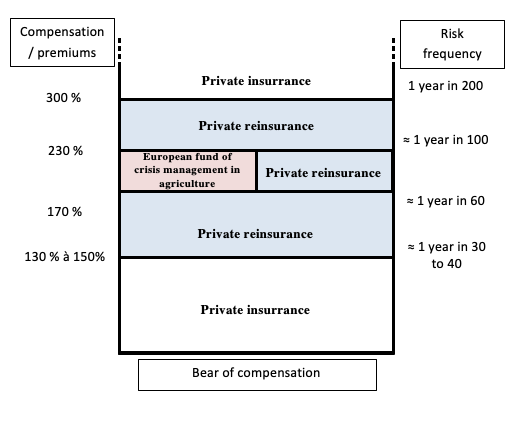
Figure 1: CAP Crisis Management Policy


By building on the decisions taken by European co-legislators to strengthen the private risk management tools co-financed by the CAP during the Financial Omnibus, the CAP reform must therefore:

– reinforce these risk management tools by increasing their attractiveness for farmers in order to offer effective response possibilities for average risk levels,

– to found a European device to take over these devices in case of deep crises. Such a scheme – the European Crisis Management Fund for Agriculture – is intended to provide secondary support after the action of risk management tools. It must be triggered on the basis of objective crisis level indicators valid for the entire European Union.

– build coherent and transparent risk and crisis management that encourages operators to react without delay to market signals and ban the delays inherent in the expectations and hopes of hypothetical interventions by the European Union and / or the national public authorities, often implemented with high deadlines.

In concrete terms, a European Crisis Management Fund in agriculture, financed by a multi-year crisis reserve and adequately equipped, should have the following missions:

  • Act in partial reinsurance of private climatic insurance that meets the conditions set out in Article 70 of the Commission’s reform proposal (CAP Strategic Plans Regulation).This measure would help to provide such climatic insurance to farmers, reduce insurance premiums while the rate of coverage in the European Union remains too low.
  • Provide second-rate support to farmers in case of market crises by taking over the income stabilization tools beyond a predefined crisis level.It will be a question of covering the part of the disbursements that these funds should operate without which these sectorial IST will not be able to survive a deep crisis of the market. Access to this second-tier aid could be open to non-IST producers, since no public aid would be allowed to substitute, even partially, with the help that ISTs would provide to their IST members. The aid released by the crisis fund, in the event of a serious crisis, would be released at European level, placing all European farmers on an equal footing. In addition, farmers covered by ISTs, such as farmers who are not, would have visibility to the ability of governments to respond to crises with predictable levels of emergency assistance. A farmer would thus knowingly do, depending on the level of risk associated with his production and investments, the choice to cover himself or not, being in the first case assured of triggering his IST and any additional contingency funds and for the second with only the second part, namely the emergency funds.
  • Create a framework for rapid interventions through exceptional market measures in the event of a crisis with a view to minimizing the effects,acting quickly to rebalance market conditions. This level of action would be discussed immediately as market disruption signals trigger the risk management tools. Depending on the situation and the need, the managing authorities would be able to intervene through ad hoc tools.

The costs of managing such a fund would be minimal, since its interventions would be anchored on the risk management tools recognized under Article 70 of the draft Strategic Plan Regulation and Article 36 of the CAP currently in force. These tools are controlled by the payment services of each country, which are audited by auditors from the European Court of Auditors and audited by the Community level.

Criteria for triggering compensation by the Crisis Management Fund for point 1 (partial reinsurance of climate insurance) and point 2 (support provided in the wake of IST triggering) would be objectively predefined at the level of the European Union:

– a ratio of 170% of indemnities to be paid/premiums paid for climatic hazards (which corresponds to a crisis recurrence of one year out of 60), the commitment of the fund being capped at a value of 230% for this same ratio (risk frequency of one year out of 100),

– recurrence of market crises beyond which the crisis is described as major and triggers the crisis management fund in agriculture.

This threshold of recurrence of market crises will have to be determined by sector at a European level. For the dairy sector, based on the analysis of operating margins and on the basis of an econometric simulation, a 12-year recurrence appears as an economic indicator of a transition to a state of major market crisis. These thresholds defined at European level would ensure the activation of the fund when needed and in the regions concerned when the crisis does not uniformly affect a given sector throughout the European Union. As this frequency of risk is defined for the whole of the Union, there will therefore be fairness between the Member States without distortion of the market on the internal market.Thanks to these indicators triggering the European Crisis Management Fund in Agriculture, the response to a serious crisis would be predictable, rapid and thus limit the scope of the crisis and prevent bankruptcies of farms. The level of stress linked to the economic risk weighing on farmers would thus be reduced as soon as the public interventions were carried out within a clear, predictable framework, defined beforehand, which would not only be beneficial from the point of view of social sustainability and the attractiveness of the farming profession, but also in terms of investment, which is necessary, in particular, to achieve the Union’s sustainable development objectives.

Regarding the dairy sector, the selected crisis level threshold (12-year recurrence) would have triggered intervention during the 2009 and 2016 dairy crises. This triggering scheme for the crisis management fund would be applicable to all sectors. The compensation paid by the fund would not be reserved solely for farmers who have subscribed to an income stabilization tool, but would benefit all farms in the country and the industry where the triggering threshold has been exceeded. Farmers who participated in a fund would benefit from the risk management fund and additional emergency assistance associated with the crisis management fund. Operators having opted not to subscribe to an income stabilization tool would still benefit from the help of the emergency fund but would obviously not have the risk coverage of the pooling tool. This would be an economic choice for each farmer, depending on the resilience of his farm. Figure 2 summarizes the use of the Crisis Management Fund in Agriculture in the case of relay of farm income stabilization instruments.

Screenshot 2018-11-27 at 16.07.13

Figure 2: Graph of the use of the European crisis management intervention fund in agriculture in the case of the agricultural income stabilization instruments relay for the dairy sector

It should be noted that the modeling carried out (see the Farm Europe technical note “Implementation of a European Crisis Management Fund for Agriculture”) results in an estimate of a total annual amount of public subsidy of € 420 million(2nd pillar CAP co-financing of 70%) for ISTs that would cover 70% of EU milk production.

The crisis management fund would intervene when IST compensation exceeds that of a risk with a frequency of one year out of 12 within the limit of a risk of one year out of 40.

Impact of this proposal for a milk producer in Germany:

This simulation is built under the assumption of the establishment of ISTs in the dairy sector in Germany, integrating only the milk component of the farms concerned. Given the characteristics of dairy farms in this country, three typical zones emerge that could encourage the constitution of specific ISTs.

Under the assumption of common IST criteria, with a deductible of 30% applying to it:

– such an IST would have intervened in support of dairy producers in 2009, 2015 and 2016 for aids paid of approximately 42 €/T in 2009, 19 €/T in 2015 and 29 €/T in 2016.

– The proposed European crisis management fund would then have covered part of these aid payments, up to € 17/t in 2009 and € 4/t in 2016.

– The annual contribution that the producers would have had to pay for this IST being, for its part, at 1.55 €/t (excluding management costs of the IST fund).


For climatic risks, the fund would make it possible to put an end to the ad hoc financial interventions decided in the emergency by certain Member States (according to their financial means and their political attentions) in the event of climate disasters. The fund would not be intended to take the role of reinsurers, but to reduce the overall cost of crop insurance by reducing the cost of reinsurance (cost reported in insurance premiums paid by farmers) and to promote the development of this tool throughout the European Union.

To ensure rigor and share the costs of reinsurance between public and private, access would be restricted provided that half of the compensation paid is derived from private funds (insurance or reinsurance). Figure 3 summarizes the use of the Crisis Management Fund in agriculture in the case of climate insurance reinsurance.

Screenshot 2018-11-29 at 11.31.35

Figure 3: Graphical representation of the use of the European crisis management intervention fund in agriculture in the case of climate insurance reinsurance


To cover 70% of European production in the cereals, industrial crops, potatoes, wine and fodder sectors, the total amount of CAP co-financing at 70% of insurance premiums would then amount to EUR 3 847 million a year.

The European Crisis Fund would then act in partial reinsurance for events of frequencies between 1/60 and 1/100. The pooling of this reinsurance risk at European level limiting the precautionary financial amounts to be put in place.


Average loss levels by crop type likely to trigger climatic hazard reinsurance by the crisis fund (Germany or France type ocean area)

Cereals: 27%               Industrial crops: 27%

Potatoes: 28%                         Vines: 31%                  Fodder plants: 33%


By building these methods of intervention of the European Agricultural Crisis Management Fund, any risk of windfall effects is eliminated:

  • in the case of intervention in response to severe climatic hazards, the fund would take over the weather insurance only for a level of serious hazards, so clearly after the normal triggering of compensations borne entirely by private insurers. This second relay action, and for only 50% of the share of the reinsurance systems for hazard levels between 170% and 230% of the ratio of compensation to pay/premium paid, excludes any risk of deadweight effect and distortion of the device.
  • in the case of intervention in response to strong market risks by releasing ISTs for recurrence crises greater than a fixed level, this device will not encourage any irresponsible individual risk-taking behavior, because only intervenes in addition to the ISTs tools set up by sectors and whose parameters have been validated by the Member States and by no means in substitution. In addition, such a system must prohibit any public aid that would replace the compensation paid by the ISTs for farmers who have chosen not to adhere to an IST. Conversely, second-tier support from the mutual fund could be provided to both IST and non-IST farmers in the region and the industry in crisis.
  • With regard to the exceptional market measures that could be decided on the basis of the voluntary milk production reduction measure set up in 2016, they must aim at rebalancing the supply/demand levels and in no way bring about an additional support to income without counterpart, which would then undermine the private risk management tools reinforced by the Financial Omnibus and confirmed in Article 70 of the proposal for a Regulation on National Strategic Plans.

Note on the compatibility of the proposed measure with the EU’s WTO commitments, the fund meets WTO green box rules for 30% deductible and compensation of up to 70% losses and for other measures is exempted from the reduction commitments of the orange box (or AMS).

The fund should have a capital of EUR 1.7 billion, which would make it possible to deal with crisis situations that may arise in different agricultural sectors and to finance adequately linked actions. This allocation may be envisaged either on the first day of the creation of the fund by decision of the Heads of State and Government in the framework of the discussions on the European Financial Framework 2021-2028 or failing that, progressively between 2021 and 2023.

Since the fund would be solicited, it would be replenished in the following year or years at the rate of € 400 million per year and within the limit of a total amount of the fund of € 1.7 billion.

This level compares favorably with the € 2.8 billion that the EU has spent to deal with only the dairy crisis. If this fund had been operational, the expenses would have been much lower.

This amount of € 1.7 billion was established in the light of the experience of past crises and the actions that would have been financed if such a fund had existed, taking into account that:

– climatic crises are more systemic in nature when they occur

– if market crises may exist in a single period in several sectors, the probability that all agricultural sectors will be affected at the same time is statistically low.

Therefore, it seems relevant and sufficiently secure that the fund has in reserve the equivalent of 4 years of action – while the risk of a continued continuation of such crises is low – due to:

– Reinsurance of climate insurance (annual precautionary allocation of 150 M €/year to the crisis management fund),

– Takeover of agricultural income stabilization instruments (annual precautionary allocation of 135 M €/year to the crisis management fund)

– Rebalancing supply/demand measures (annual precautionary allocation of 130 M €/year to the crisis management fund)

– with an additional 5 million €/year to finance the communication tools on risk management tools, research and development on risks in agriculture in Europe.

Solidarity and mutualisation allow economic efficiency, which is a foundation of European agricultural policy as it was put forward when the CAP was created.


NB: In this scheme, traditional crisis measures such as public intervention and private storage aid should continue to be financed in addition to these credits, as they are now financed outside the crisis reserve. It should be noted, however, that the use of rebalancing measures (so with quick and targeted triggers) would significantly reduce the need for a public storage policy.

POLICY BRIEFING EU budget & the CAP 2021-2027: understanding the Commission’s proposals

2018

On May 2, the European Commission proposed its budget orientations for the period 2021-2027 for the European Union and its policies. Since then, many analyzes and comments have been made, putting forward variable figures as to the real financial impact of these proposals for the CAP.

This note aims:

– to decipher these different analyzes which, if they are all mathematically exact, give very variable readings of the Commission’s proposals

– to highlight the actual economic impact of the said proposals on European agricultural sectors and on the incomes of European farmers.


  1. Presentation by the Commission: A rising budget for the EU27, a CAP budget in reduction of “only” 5%

The European Commission has presented its proposal as an ambitious budget to address new priorities and boost the European momentum.

At the same time, it appears that the proposed budget, expressed as a percentage of the EU27 GDP, is decreasing compared to the European actions currently financed in the 27 Member States. While the implementation of current EU policies in the EU27 now accounts for 1.16% of EU27 GDP, the budget for the coming period is proposed at 1.11% to finance both but also what is proposed as new priorities. So less money than the one currently used for existing European policies in the EU27 for more actions to be financed.

Therefore, the financing of the so-called new priorities proposed for the EU (defense, immigration, digital …) supposes in the Commission’s plan to ask the existing policies to cut their budgets both to compensate for the departure of the British net contributor and to fund the proposed new policies. This is the case for the CAP for which the Commission proposes a decrease of 19.6 billion in current euros over the period, plus a loss in real annual value of the amount of inflation, accentuating the erosion initiated since the 2000s of the CAP budget in the European budget.


– While the Commission’s budget proposal increases by 2% (theoretical inflation rate) per year the national contributions that Member States will have to pay to the EU budget,

– While the production costs of the agricultural and agri-food sectors will most likely follow the evolution of inflation in the EU27,

the expression of the evolution of the CAP budget in current euros does not make it possible to give a real and objective reading of the economic impact of the proposals presented on the European agricultural and agri-food sector.


II-        Analysis conducted by the European Parliament: comparison of the two budget periods reported in euros 2018.

By choosing to compare the Community funding allocated to the different policies in 2018 euros for the period 2014-2020 and for 2021-2027, the European Parliament points out a difference, for the current heading 2 (mainly the CAP), of -21% between the two periods, the Commission’s proposal for the coming period then being less than € 90 billion 2018.

It should be noted that a 2014-2020 budget expressed in 2018 euros results in a larger amount (number of euros) than the decision of the Heads of State and Government in 2013, which decided to maintain the CAP budget in current euros only.

At the same time, expressing the Commission’s budget proposal for the period 2021-2027 in 2018 euros leads to the inclusion of the lack caused by the non-indexation on the inflation rate for the years 2019 and 2020 even though it can not be imagined to modify the decision taken in 2013. Consequently, in view of the decisions taken and accepted in 2013 for the period up to 2020, the expression of the 2021-2027 budget in 2018 euros increases the lack of the CAP budget proposed by the Commission for the period. And to be noted that what is linked to non-indexation on inflation from 2018 has a cumulative effect (by multiplying each year by a factor of 1.02) in the end of the period 2027.


III –     Analysis of the Bruegel Institute: comparison of the 2014-2020 CAP budget expressed in current euros and the 2021-2027 proposal expressed in 2018 euros.

Through its analysis comparing the 2014-2020 CAP budget expressed in current euros (strictly taking into account the 2013 European Council decision) with a 2021-2027 budget translated into 2018 euros, the Bruegel Institute concludes a lower Commission proposal of -15% than what would have been necessary to keep the CAP budget at its previous level expressed in 2018 euros, thus to maintain this budget in value (real terms) 2018, lack decomposing for the 1st pillar by a lack of -13 % and the second pillar by a lack of -23%.

This analysis leads to the calculation of what should have been the Commission’s proposal to maintain the value of the previous CAP budget in real terms in 2018. Consequently, it is dispensing with the decision of the European Council of a non-indexed CAP inflation until the end of 2020 and returns to calculate the shortfall compared to a CAP budget which would be indexed to inflation not only during the entire period 2021-2027 but also from 2019 and 2020 at a rate of 2% per year, an increase of a factor of 1.0404 compared to a budget maintained in real terms only over the period 2021-2027.


IV –     Comparison between the level of CAP aid (CAP budget) 2020, aid paid to the United Kingdom excluded, and Commission’s proposal for 2021-2027: determination of the lack in relation to an objective of maintaining the CAP budget for the EU27 in real value 2020 (euros2020).

Considering that the decision taken in 2013 by the European Council will not be called into question for the period 2013-2020, the comparison of the levels of CAP budgets proposed by the Commission for the years 2021 to 2027 must then be made with the level of the last year of the current budget period: 2020. This year includes the consequences of all the decisions taken in 2013.

For the EU27, excluding CAP aid to the UK, the 2020 CAP budget is € 56.6 billion, with € 41.35 billion for the first pillar and € 15.3 billion for the second pillar.

Maintaining for EU27 farmers this 2020 level of CAP support for each of the years from 2021 to 2027 would entail increasing the 2020 amounts by 2% (inflation rate used by the Commission to determine the evolution of national contributions EU budget) per year, from one year to the next.

The table below shows (in bold) the amounts that are missing each year from the Commission’s proposal, for each pillar, to make up the difference between the Commission’s said proposal and a target to maintain the CAP budget in real terms at the level of the year 2020.

In total, the Commission’s proposal is 12% lower than it would be to meet this target, due to a shortfall of -9.56% (27.37 billion euros over the period 2021-27) for the 1st pillar and a lack of -21% (€ 16.23 billion over the period) in the 2nd pillar.

Farm Europe, May 2018

These rates take into account the entire period. It should be borne in mind that due to the non-compensation of inflation in the Commission proposal, the situation is deteriorating from year to year, the difference reaching for the year 2027 a -14,85 % for the 1st pillar of the CAP.

The Commission’s proposal would have a substantial impact on the evolution of farm incomes in the Member States because of this significant lack of funding as CAP aids represent on average 46% of agricultural incomes in the EU.

These revenues would be reduced by the mere fact of the proposed evolution of the agricultural budget (thus excluding the impact of the CAP reform that will be presented at the beginning of June ; the impact of the CAP reform that will be proposed is evaluated in addition, with a constant CAP budget, by the Commission services between – 8% and – 10% minimum income for European farmers) of:


Impact of the Commission’s PAC budget proposal on the evolution of average farm incomes Evolution of average incomes over the period 2021-2027 (%) Impact on average agricultural income for the year 2027 (%)
Belgium -5,45 -7,48
Bulgaria -4,71 -6,46
CZ Republic -13,27 -18,19
Danemark -26,91 -36,89
Germany -7,07 -9,69
Estonia -5,83 -7,99
Irland -7,44 -10,2
Greece -5,21 -7,14
Spain -3,10 -4,25
France -6,32 -8,67
Croatia -1,86 -2,55
Italy -3,59 -4,93
Cyprus -2,32 -3,06
Latvia -5,33 -7,31
Lituania -7,32 -10,03
Luxembourg -10,29 -14,11
Hungary -6,07 -8,33
Malta -0,74 -1,02
Netherlands -3,35 -4,59
Autria -4,71 -6,46
Poland -3,47 -4,76
Portugal -4,96 -6,80
Roumania -2,73 -3,74
Slovenia -3,59 -4,93
Slovakia -60,76 -83,30
Finland -6,69 -9,18
Sweden -10,91 -14,96
EU27 -8,31 -11,39

Farm Europe – May2018 – Assessment of the impact on the evolution of European farm incomes of the Commission’s proposal for a CAP budget

Annex: European Commission tables – communication on the 2021-2027 budget

European Commission


BREXIT AND TRADE NEGOTIATIONS A PERFECT STORM TAKING SHAPE

 I – BREXIT

Brexit has been a top issue of every Global Food Forum. The paper circulated last year for discussion started by stating that “The political shock of Brexit has yet to be translated in actual economic and commercial terms, but the clock is already ticking”.

The clock has moved on and Brexit is now around the corner, it will happen in 6 months’ time. What is the state of the negotiations? Which are the likely prospects? Which are the consequences of the most likely outcomes for the key agri-food sectors in the EU?

We are at a stage where though we are only a few months away from Brexit, we still have more questions than answers. As a matter of fact the only practical certainty is that on 29th March 2019 the UK will no longer be a member of the EU. A total reversal of Brexit does not square with the current political landscape in the UK, and time is running short.

The level of uncertainty at this stage is staggering. There is no clarity on the shape of the post-Brexit relationship between the EU27 and the UK. The status of the border in Ireland has been a major stumbling block, and no clear acceptable solution has been found so far. The political situation in the UK only adds to the uncertainty on the outcome of the negotiations.

Notwithstanding there are many who believe the EU and the UK will find a “way-out” of the current mess that will protect economic interests in both sides. The preliminary understanding to extend the participation of the UK in the single market till end 2020 adds to a (dangerous) perception that probably nothing fundamental will change.

To examine in more depth were we really are it is useful to start by realizing that Brexit should be seen as a process, rather than a single event.

That process has evolved in the last year. There was an understanding that enabled the EU to accept engaging in negotiations on the future of the relationship, including its trade terms. As said above one of the elements of that understanding was the maintenance of the UK in the single market till end 2020, to give more time for a global solution to be found that avoids the return to a hard border in Ireland.

Not much more has been achieved. Even the understanding on the crucial issue of avoiding a hard border in Ireland is little more than a fudge, as it is not feasible under the terms expressed in the understanding. Sill that fudge has opened the door for negotiations on the future relationship to start, and that in itself was a positive move.

The problem is that the negotiations have not moved substantially since then. The UK accepts that a hard Irish border should be avoided. But the UK does not want to replace a hard border between the Republic of Ireland and Northern Ireland, by a hard border between Northern Ireland and the rest of the UK. If the UK, as is its current Government position, does not want to stay in the single market, nor in the customs union, with all its obligations, there is no practical solution that has been offered that would square the circle between being out and not having a hard border with the EU. How would the flow of goods from third countries be controlled if they could freely cross the border from Northern Ireland? How would the EU tariff border protection and the conformity with EU standards and regulations be enforced? By the UK under delegation from the EU? Which guarantees would the EU have in particular if the UK would no longer accept the jurisdiction of the European Courts?

The inescapable conclusion is that there is no model in sight that would avoid a hard border other than the UK staying in the single market. The UK might accept to extend the transitional period beyond end 2020, but stretching that date too much would face a powerful backlash from those who do not accept to be out of the EU, but still subject to EU rules and contributing to the EU budget without a seat at the table.

Unsurprisingly the UK Government is pursuing intermediate outcomes that would protect her economic interests. One option put forward in July would be to stay in the single market, but only for goods thus excluding services, and still having the freedom to adopt free trade agreements with third countries. That option would avoid the need for a hard border, and keep the status quo as far as trade in goods is concerned. Those could be good news in particular for the EU agri-food sector as it would keep the current situation, the EU27 enjoying a healthy trade surplus with the UK. Not to mention all the other sectors where the EU27 has a positive trade balance, and those are clearly dominant.

The problem with that intermediate option from a trade viewpoint is twofold: first in many areas trade in services and trade in goods are inseparable; and second if the UK would adopt free trade agreements with the likes of the US, Australia, New Zealand, why not Mercosur, the competition for agri-food products in the UK market would dramatically change against our interests, and the EU market would be open to trade diversion and cheaper products imported into the UK. That might not be a big problem for other economic sectors that have low or no tariff protection, but would definitely be a big problem for the agri-food sector. We need to ask again: how would the flow of goods from third countries be controlled if they could freely cross the border from Northern Ireland? How would the EU tariff border protection and the conformity with EU standards and regulations be enforced? If by the UK under delegation from the EU, which guarantees would the EU have in particular if the UK would no longer accept the jurisdiction of the European Courts?

We need to be reminded again that we are a bare 6 months from Brexit actually happening. The lack of politically viable solutions is alarming. Whereas the understanding to keep the UK in the single market till end 2020 is no more than an understanding, dependent upon a formal agreement on the next 6 months to gain legal value, the possibility of a hard Brexit (with a hard border) is now higher than ever before but by no means the only possible outcome.

The consequences of a hard Brexit are so dear for the UK, and to some sectors in the EU – the agri-food sector first and foremost – that another possible outcome is to agree to extend the transitional period to give the time to both parties to reach an agreement for the future relationship. One would hope that with the UK already outside the EU the mindset of negotiators and the political climate would be more conducive to finding a solution, so elusive so far. In this scenario we would probably be back to negotiating the largest possible free trade agreement, which for the EU agri-food sector would be better than a hard Brexit but clearly much worse than the current situation – as the UK would also certainly strike free trade agreements  with some of the very competitive third countries mentioned above.

Anyhow prospects are not good. The next chapters deal with the Brexit impact on the key EU agri-food sectors – beef, pork, poultry, sheep and goat meat, dairy, sugar, wine – to illustrate and raise awareness to the challenges ahead.


General overview of current trade

60% of the agriculture and food products consumed in the UK are imported. And nearly 75% of these are coming from the EU.

Last year the EU27 exported over €38 billion worth of agri-food products to the UK, and imported only €16 billion – a trade surplus of €22 billion.

The UK is a major outlet for traditional agri-food export countries such as the Netherlands (€6.5 billion), Ireland (€5.4 billion), France (€5.4 billion) and Germany (€5.1 billion).

The agri-food sector in Spain (€3.8 billion), Italy (€3.1 billion), Belgium (€2.9 billion), Poland (€1.9 billion) and Denmark (€1.7 billion) are also exposed to Brexit with certain sectors facing serious risks.

A cautionary word is appropriate as the figures for The Netherlands and Belgium might reflect to a large extent the relevance of their ports, rather than domestic production. But that does not diminish the finding that many EU countries have substantial trade interests in the UK market.

Table 1: Overview of EU/UK agri-food trade in 2017 (Source: HMRC, UK Gov)

Dispatch from the UK (Euros2017) Arrival to the UK

(Euros2017)

Austria 89.801.177,28 262.319.627,65
Belgium 799.908.307,59 2.866.356.399,84
Bulgaria 68.551.981,72 65.547.096,60
Croatia 25.782.289,30 8.547.571,02
Cyprus 94.038.267,09 97.009.688,96
Czech Republic 146.960.068,62 168.623.918,42
Denmark 426.699.362,66 1.713.758.771,52
Estonia 30.412.539,19 11.302.386,59
Finland 138.577.822,80 43.705.468,73
France 2.734.523.101,07 5.379.809.291,58
Germany 1.643.250.247,51 5.118.324.966,07
Greece 153.158.103,85 356.268.112,87
Hungary 61.468.589,82 190.632.540,77
Irish Republic 4.599.262.510,30 5.395.789.091,28
Italy 663.652.013,60 3.127.815.529,79
Latvia 192.582.213,11 61.364.804,46
Lithuania 31.919.482,99 137.225.712,69
Luxembourg 9.631.353,29 8.723.322,67
Malta 68.539.359,97 4.080.038,00
Netherlands 1.873.114.189,49 6.541.486.997,90
Poland 442.847.817,00 1.930.722.826,51
Portugal 198.052.147,71 334.559.710,44
Romania 84.862.443,22 204.507.851,55
Slovakia 27.556.642,43 74.014.482,70
Slovenia 20.783.834,16 20.176.250,51
Spain 1.135.634.933,57 3.754.265.086,64
Sweden 398.067.072,15 508.952.955,02
Total €16.159.637.871,46  €38.385.890.500,78 


Sectorial overview of the EU-UK post- Brexit trade challenges


Meat products: a further chill for EU beef

It is clear that in the absence of a FTA with the UK the trade in meat products would collapse, as the fallback WTO tariffs are high enough to prevent any meaningful trade flows. Even if a FTA is in place the real game for the future of this trade is tied with the terms of the FTAs between the UK and the rest of the world. As mentioned above it is foreseeable that UK will negotiate FTAs with countries such as the US, Australia, Argentina, Brazil that would pave the way for a significant share of imports from these countries into the 65 million people British market. EU exporters will in the future have to compete with the most competitive meat producers in the world. It is therefore illusory to think they will keep their UK market share, on the contrary they should expect it to shrink significantly.

For meat products, the cascade effect of trade agreements between the UK and the rest of the world will have to be carefully addressed. Serious safeguards on future UK exports will be needed to avoid that a post-Brexit UK open to the global meat market does not lead to a de facto opening of the EU to the world market, by diverting the UK meat production to the EU market and satisfying UK’s consumption needs through imports.

Over €1 billion of EU beef meat products are routed to the UK every year, mostly from Ireland (€785 million). The trade surplus in favour of the EU27 is over €600 million. This is an additional sword of Damocles for the whole EU beef sector, which is already under pressure from the EU trade agenda while facing a structural crisis at the same time.

In addition, the upcoming UK FTAs with top world beef producers would have an indirect effect, by pushing Irish beef producers to find new outlets in the world market but also and primarily in the EU domestic market. The impact on prices, in particular on the more valuable cuts, would be devastating to the already fragile economic situation of the sector.

The EU27 enjoys even a higher surplus on the pig meat sector, over €800 million in 2017 for more than €1 billion of exports. Danish, German, Dutch and Irish pig producers will be the ones most affected. Brexit would come on the top of difficult conditions with Russia, leading to an enhanced dependence on exports to China.

To confirm that no meat sector would be spared, in poultry meat the EU27 exports over €1.2 billion to the UK, the trade surplus being even higher than for the other meats just shy of €900 million. The Netherlands and Poland are by far the biggest exporters.

In turn, the UK is expected to pay a special attention to the €440 million trade flow of sheep meat exported or re-exported, in particular in the context of its future new bilateral relations with the New Zealand. A very significant share of this trade flow is channeled to the French market (€200 million). New Zealand producers benefit from a 280 000 tons tariff free quota to the EU. They see the Brexit as an “opportunity in time of change”.


Table 2: Overview of EU/UK bovine trade in 2017 (Source: HMRC, UK Gov)

BEEF Dispatch from the UK

(Euros2017)

Arrival to the UK

(Euros2017)

Austria 1.456.827,66 5.727.297,42
Belgium 15.450.650,68 8.107.493,02
Bulgaria 4.368.956,32 56.768,17
Croatia
Cyprus 437.843,92 43.037,38
Czech Republic 2.706.634,56 47.887,77
Denmark 10.692.518,66 5.192.296,21
Estonia
Finland 341829,908 66.893,41
France 52.449.310,00 8.626.605,81
Germany 22.997.553,29 36.528.152,00
Greece 1.903.216,53 2.130,25
Hungary 22.079,49 52.482,58
Irish Republic 143.601.118,65 784.933.069,39
Italy 31.835.649,15 11.355.261,67
Latvia 124.637,14
Lithuania 87.014,94
Luxembourg 100.527,81
Malta 578.401,43 3.289,50
Netherlands 96.713.819,67 83.092.852,63
Poland 4.534.575,89 73.455.096,04
Portugal 5.744.389,60 1.660.698,12
Romania 570.250,12 98.986,31
Slovakia 290.425,58
Slovenia 7.908,27
Spain 9.712.575,38 9.646.310,66
Sweden 5.227.239,34 35.841,09
Total € 411.955.953,98  € 1.028.732.449,42 

(Live bovine animals; Meat of bovine animals, fresh or chilled; Meat of bovine animals, frozen)


Table 3: Overview of EU/UK swine trade in 2017 (Source: HMRC, UK Gov)

SWINE  Dispatch from the UK (Euros2017) Arrival to the UK

(Euros2017)

Austria 4.995,30 4.900.734,20
Belgium 7.864.920,99 68.305.622,70
Bulgaria 670.647,85 171.906,48
Croatia 97.766,59
Cyprus 236.944,62
Czech Republic 824.035,91
Denmark 38.692.210,25 333.727.792,51
Estonia 179.861,54
Finland 3461,794 52.255,52
France 5.774.171,98 50.898.761,75
Germany 42.967.201,80 211.406.645,62
Greece 55.594,08 12.299,98
Hungary 185.903,13 465.678,61
Irish Republic 95.013.500,33 141.456.512,17
Italy 1.200.622,96 11.459.286,64
Latvia 41.466,22 18.833,35
Lithuania 134.255,77
Luxembourg 1.179,79
Malta 88.309,98
Netherlands 12.442.088,13 108.829.901,28
Poland 2.930.259,15 34.106.074,85
Portugal 289.633,72 6.092.751,74
Romania 787.148,52 2.797.244,79
Slovakia 250.845,43 18.688,44
Slovenia
Spain 3.079.349,06 86.389.877,10
Sweden 7.585.332,63 43.716,27
Total € 221.401.707,49  € 1.061.154.583,99

(Live swine; Meat of swine, fresh, chilled or frozen)


Table 4: Overview of EU/UK poultry trade in 2017 (Source: HMRC, UK Gov)

POULTRY Dispatch from the UK (Euros2017) Arrival to the UK

(Euros2017)

Austria 130.889,82 371.355,57
Belgium 5.861.387,74 53.663.620,40
Bulgaria 581.470,72 1.680.596,02
Croatia 5.358,14
Cyprus 512.520,09
Czech Republic 1.390.452,27 2.868,47
Denmark 8.937.996,12 8.797.408,94
Estonia 1.175.117,04 1.694,39
Finland 235401,992
France 40.339.373,82 36.978.560,61
Germany 31.531.636,55 108.818.062,26
Greece 1.166.499,07 23.616,42
Hungary 11.885.385,10 14.077.939,83
Irish Republic 85.485.245,52 129.259.110,35
Italy 5.381.396,43 28.677.118,12
Latvia 1.825.231,46 4.416,81
Lithuania 415.860,27 1.132.634,19
Luxembourg 1.983,06
Malta 951.102,23
Netherlands 46.141.752,47 514.886.615,99
Poland 14.126.588,64 261.652.273,86
Portugal 4.054.877,81 354.318,15
Romania 7.836.540,89 30.712.125,85
Slovakia 915.901,24
Slovenia 524,39 127.911,81
Spain 29.157.463,15 14.647.169,89
Sweden 4.468.466,35
Total 304.516.422,34 € 1.205.869.417,91 €

(Live poultry, “fowls of the species Gallus domesticus, ducks, geese, turkeys and guinea fowls”; Meat and edible offal of fowls of the species Gallus domesticus, ducks, geese, turkeys and guinea fowls, fresh, chilled or froze)


Table 5: Overview of EU/UK sheep and goats trade in 2017 (Source: HMRC, UK Gov)

SHEEP&GOATS Dispatch from the UK (Euros2017) Arrival to the UK

(Euros2017)

Austria 4.269.951,75 333,17
Belgium 48.895.554,83 397.713,81
Bulgaria 1.119.185,22 149.502,95
Croatia
Cyprus 76.035,10
Czech Republic 185.915,68
Denmark 2.182.483,12 62.968,37
Estonia
Finland 32964,631
France 203.038.750,15 1.301.834,22
Germany 70.903.183,37 1.775.942,54
Greece 121.190,17
Hungary 7.724,57
Irish Republic 48.659.424,88 23.796.912,79
Italy 24.279.660,76 6.478,60
Latvia 39.142,01
Lithuania
Luxembourg 3.917,05
Malta 45.322,80
Netherlands 23.147.396,26 5.025.147,70
Poland 2.104.875,72 131.380,45
Portugal 6.151.747,14
Romania 79,87 33.690,31
Slovakia 6.159,12
Slovenia 7.739,40
Spain 3.045.294,77 4.656.336,57
Sweden 785.099,28 84.181,84
Total € 439.108.797,65  € 37.422.423,30

(Live sheep and goats; Meat of sheep or goats, fresh, chilled or frozen)


Wine and spirits: New World wines and Scotch whisky

For more than 20 years EU wine producers have been working hard to stop the drain of their market share in the British market. Their efforts to repel the New World onslaught could be short lived as a result of Brexit and the UK’s expected opening to New World exports. The willingness of the UK to open its market to New World countries for the wine sector will seriously reduce the attractiveness of the British market for the EU wine sector, and likely erode its market share in any case, and more so if we have to face a hard Brexit (although tariffs are much lower than for meat products).

The UK is a large market for traditional EU wine makers at €2.6 billion, with France leading the way (€1.1 billion), followed by Italy (€780 million) and Spain (€280 million).

The UK will also be willing to secure a preferential access to the internal market for Scotch whiskies, which is indeed particularly sensitive from an UK economic point of view.

This tariff line (more than €1.7 billion) represents 10% of the UK’s agri-food exports, with France, Germany and Spain being the main outlets.


Table 6: Overview of EU/UK wine products trade in 2017 (Source: HMRC, UK Gov)

WINE Dispatch from the UK

(Euros2017)

Arrival to the UK

(Euros2017)

Austria 2.559.715,98 € 6.681.710,83 €
Belgium 10.243.458,72 € 37.312.632,85 €
Bulgaria 337.924,27 € 2.083.610,91 €
Croatia 146.554,60 € 56.925,63 €
Cyprus 2.079.561,50 € 181.148,58 €
Czech Republic 3.936.202,40 € 1.792.643,36 €
Denmark 29.215.769,39 € 13.474.081,55 €
Estonia 1.644.241,47 € 35.430,33 €
Finland 6.392.979,64 € 328.566,92 €
France 56.216.089,88 € 1.134.425.937,95 €
Germany 32.406.452,66 € 174.894.669,58 €
Greece 315.718,12 € 2.736.686,22 €
Hungary 568.801,05 € 9.940.844,98 €
Irish Republic 55.678.918,49 € 16.229.524,67 €
Italy 3.802.521,70 € 775.860.992,08 €
Latvia 5.801.067,64 € 46.277,82 €
Lithuania 863.229,26 € 108.765,83 €
Luxembourg 131.097,48 € 533.164,20 €
Malta 974.168,69 € 69.156,01 €
Netherlands 61.023.895,34 € 24.297.869,98 €
Poland 4.104.155,32 € 10.940.503,60 €
Portugal 670.431,06 € 69.041.524,34 €
Romania 376.184,28 € 5.368.749,58 €
Slovakia 273.174,80 € 831,79 €
Slovenia 129.401,95 € 520.208,14 €
Spain 15.880.933,19 € 282.231.105,69 €
Sweden 19.621.716,53 € 9.990.104,23 €
Total € 315.394.365,39  € 2.579.183.667,66

(Wine of fresh grapes, incl. fortified wines; grape must, partly fermented and of an actual alcoholic strength of > 0,5% vol or grape must with added alcohol of an actual alcoholic strength of > 0,5% vol; Vermouth and other wine of fresh grapes, flavoured with plants or aromatic substances)


Table 7: Overview of EU/UK spirits (obtained by distilling grape wine or grape marc) products trade in 2017 (Source: HMRC, UK Gov)

SPIRITS Dispatch from the UK

(Euros2017)

Arrival to the UK

(Euros2017)

Austria 745.705,11 € 2.328.596,16 €
Belgium 2.033.606,58 € 19.868.701,95 €
Bulgaria 128.321,42 € 28.159,88 €
Croatia 99.116,39 € 12.828,26 €
Cyprus 706.087,31 € 65.788,92 €
Czech Republic 180.560,97 € 1.683.283,07 €
Denmark 3.916.318,20 € 6.828.469,68 €
Estonia 326.003,10 € 36.920,48 €
Finland 925.397,78 € 13.645,22 €
France 12.333.131,76 € 228.595.001,65 €
Germany 7.694.556,00 € 29.921.475,61 €
Greece 186.822,78 € 822.293,60 €
Hungary 436.861,52 € 1.254.508,96 €
Irish Republic 13.391.937,54 € 13.434.110,04 €
Italy 5.153.482,82 € 50.631.150,47 €
Latvia 283.724,48 € 66.427,88 €
Lithuania 379.671,17 € 20.637,27 €
Luxembourg 65.802,61 € 619,56 €
Malta 400.826,45 €
Netherlands 8.949.003,34 € 12.735.619,51 €
Poland 674.165,56 € 10.903.264,79 €
Portugal 333.764,18 € 4.954.340,66 €
Romania 313.267,26 € 1.225.739,79 €
Slovakia 199.172,96 € 831,79 €
Slovenia 129.609,61 € 228.975,88 €
Spain 8.123.908,59 € 26.359.739,13 €
Sweden 1.600.716,89 € 8.601.283,59 €
Total € 69.711.542,36  € 420.622.413,78 


Sugar and sugar products: refining of sugar cane flooding the EU market?

Having the UK open to the world market will change drastically the EU sugar landscape, and the difficult balance reached between sugar beet and cane refiners. The longstanding tensions between the continental sugar beet cooperatives (German, French and Dutch) and the US owned cane sugar refining company (American Sugar Refining –Tate&Lyle, which owns, in London, 25% of the total refining capacity in the EU) are about to rebound.

On the one hand, the EU sugar producers are enjoying an important outlet in the British market (€970 million). On the other hand, Tate&Lyle is poised to regain competitiveness from UK FTAs with sugar cane producing countries. In this case, assuming that the beet sugar producing company maintains its production, the British market would most probably be in a position to switch from a deficit to a surplus position.

Restrictions via current EU strict rules of origins for the sugar sector will need to be implemented to the UK to avoid a damaging triangular trade in a post-Brexit context, taking into account that raw sugar refining into white sugar is not considered as a substantial transformation allowing operators to rebrand it as “local products”.


Table 8: Overview of EU/UK sugar products trade in 2017 (Source: HMRC, UK Gov)

SUGAR Dispatch from the UK

(Euros2017)

Arrival to the UK

(Euros2017)

Austria 3.544.084,06 € 2.300.718,11 €
Belgium 16.795.677,46 € 179.627.172,46 €
Bulgaria 619.875,63 € 1.083.349,83 €
Croatia 194.524,53 € 72.563,04 €
Cyprus 2.033.303,08 € 11.391,74 €
Czech Republic 2.720.512,54 € 41.234.284,08 €
Denmark 10.619.931,67 € 11.202.972,40 €
Estonia 367.544,63 € 23.613,00 €
Finland 2.132.546,12 € 9.908.677,91 €
France 23.961.729,10 € 255.426.222,52 €
Germany 31.431.212,58 € 133.142.309,88 €
Greece 1.457.578,44 € 6.229.543,94 €
Hungary 710.638,76 € 8.513.943,47 €
Irish Republic 121.924.561,54 € 44.262.294,99 €
Italy 23.343.349,32 € 19.024.223,89 €
Latvia 295.867,01 € 645.351,88 €
Lithuania 1.365.932,18 € 506.467,08 €
Luxembourg 384.477,07 € 86.916,82 €
Malta 2.434.711,44 € 2,28 €
Netherlands 35.940.517,60 € 157.756.964,82 €
Poland 14.635.140,33 € 35.129.764,08 €
Portugal 2.845.615,21 € 1.362.188,56 €
Romania 1.071.422,96 € 386.193,13 €
Slovakia 1.111.615,83 € 8.325.992,24 €
Slovenia 812.900,89 € 1.534,65 €
Spain 12.564.966,98 € 46.237.124,09 €
Sweden 8.490.372,69 € 2.041.295,78 €
Estimates 346.179,40 € 3.541.381,03 €
Total € 324.156.788,99  € 968.084.457,68 


Milk and milk products: more competition in a big market

The challenge of Brexit for the milk sector is more than significant (€3.7 billion EU27 exports). Once again, Ireland (€875 million) but also France (€678 million), Germany (€465 million), The Netherlands (€265 million) and Italy (€232 million) have serious interests in the British market.

Even if the trade balance is not in its favour, the UK also has a significant market position in Ireland (in particular via Northern Ireland) and France. In total, nearly €1.5 billion of dairy products are exported or re-exported from the UK to the EU internal market.

To put it into perspective, the volumes of butter exported to the UK are three times those exported to Russia, and cheese volumes are the double. It is worth remembering the devastating impact of the Russian ban on the EU dairy market, already shaken by higher levels of production.

A hard Brexit would dwarf the Russian crisis, but even in the event of a UK-EU27 FTA, a UK FTA with New Zealand and with the US would inevitably bring added competition in the UK market for EU exporters, which would face an erosion of their market share. The losses in the UK market would lead to increased pressure on the EU-27 internal market and to another dairy crisis.


Table 9: Overview of EU/UK dairy products trade in 2017 (Source: HMRC, UK Gov)

DAIRY PRODUCTS Dispatch from the UK

(Euros2017)

Arrival to the UK

(Euros2017)

Austria 3.183.949,09 € 14.302.933,62 €
Belgium 117.922.502,89 € 244.524.751,39 €
Bulgaria 3.102.309,40 € 2.309.268,76 €
Croatia 689.133,19 € 70.302,72 €
Cyprus 6.168.891,81 € 69.488.246,38 €
Czech Republic 5.540.827,22 € 6.416.682,78 €
Denmark 60.983.982,02 € 265.800.359,97 €
Estonia 680.636,17 € 210.238,38 €
Finland 2.792.831,41 € 2.613.926,03 €
France 173.682.535,08 € 678.384.348,87 €
Germany 123.902.583,16 € 465.225.006,31 €
Greece 12.440.353,81 € 111.889.684,47 €
Hungary 2.717.357,68 € 3.366.449,76 €
Irish Republic 608.137.326,08 € 906.148.741,32 €
Italy 57.357.676,36 € 327.570.200,03 €
Latvia 758.448,94 € 550.917,02 €
Lithuania 2.067.341,39 € 5.582.106,31 €
Luxembourg 360.103,02 € 619,56 €
Malta 4.187.729,01 € 38.312,50 €
Netherlands 205.749.127,19 € 296.648.515,84 €
Poland 24.114.358,39 € 93.824.215,49 €
Portugal 8.499.368,33 € 8.083.630,15 €
Romania 3.810.326,14 € 5.838.581,43 €
Slovakia 1.211.371,18 € 28.881.177,98 €
Slovenia 353.699,73 € 228.975,88 €
Spain 59.079.420,25 € 91.471.885,39 €
Sweden 15.509.618,71 € 16.966.648,32 €
Estimates 1.177.201,65 € 13.251.109,61 €
Total 1.506.181.009,27 € 3.659.687.836,25 €

(Milk and cream, not concentrated nor containing added sugar or other sweetening matter; Milk and cream, concentrated or containing added sugar or other sweetening matter; Buttermilk, curdled milk and cream, yogurt, kephir and other fermented or acidified milk and cream, whether or not concentrated or flavoured or containing added sugar or other sweetening matter, fruits, nuts or cocoa; Whey, whether or not concentrated or containing added sugar or other sweetening matter; products consisting of natural milk constituents, whether or not containing added sugar or other sweetening matter, n.e.s.; Butter, incl. dehydrated butter and ghee, and other fats and oils derived from milk; dairy spreads; Cheese and curd)


Fruits and vegetables: is the carbon foot print a sufficient argument for preferring EU origin?

With about €5.1 billion of fruits and vegetables exported from the EU27 to the UK, it’s clear that EU producers are heavily exposed to the Brexit consequences. Spain (€1.9 billion) and The Netherlands (€ 1.1 billion) top the list.

Many other countries are also concerned, such as Italy, Belgium, Ireland, Poland, France, Germany, Greece or Cyprus, which is traditionally exporting potatoes to the UK (€6 million).

The challenge for EU exporters could come from freer access to the UK market from exporters in North Africa and the US.

Nevertheless, the proximity to the market should allow EU producers to keep strong positions, even under enhanced competition with the rest of the world.


Table 10: Overview of EU/UK fruits and vegetables trade in 2017 (Source: HMRC, UK Gov) 

FRUITS&

VEGETABLES

Dispatch from the UK

(Euros2017)

Arrival to the UK

(Euros2017)

Austria 2.951.234,15 € 3.550.442,85 €
Belgium 31.723.011,92 € 312.160.278,48 €
Bulgaria 266.005,89 € 790.059,21 €
Croatia 725.452,36 € 217.768,98 €
Cyprus 1.128.414,77 € 15.164.509,56 €
Czech Republic 2.802.036,99 € 347.962,78 €
Denmark 4.108.252,65 € 7.374.292,13 €
Estonia 114.920,38 € 31.386,63 €
Finland 1.598.107,42 € 156.281,63 €
France 70.146.578,28 € 390.957.130,33 €
Germany 35.521.250,30 € 504.303.376,60 €
Greece 4.980.782,20 € 73.241.540,78 €
Hungary 1.143.669,94 € 20.019.792,03 €
Irish Republic 212.789.595,81 € 216.241.313,64 €
Italy 27.415.857,86 € 280.027.053,10 €
Latvia 108.976,91 € 78.408,38 €
Lithuania 770.101,98 € 2.431.382,00 €
Luxembourg 85.989,18 € 53.495,79 €
Malta 1.764.575,90 € 1.257.045,41 €
Netherlands 77.899.668,71 € 1.120.829.973,64 €
Poland 22.391.595,58 € 215.405.781,02 €
Portugal 4.780.536,70 € 78.545.182,62 €
Romania 374.278,81 € 4.086.623,86 €
Slovakia 1.421.063,01 € 1.933.413,09 €
Slovenia 510.047,54 € 203.768,91 €
Spain 47.557.045,45 € 1.862.768.149,17 €
Sweden 10.443.796,64 € 1.307.070,27 €
Estimates 2.460.171,71 € 14.312.098,13 €
Total € 567.983.019,04  € 5.127.795.580,99 


II – TRADE NEGOTIATIONS

The FTAs that the EU is actively pursuing will add once implemented to the woes of some important sectors, whilst providing welcome export opportunities to others.

The sector that risks the higher negative impact is beef. With the notable exception of the FTA with Japan where the EU is expected to develop to some extent its exports, the FTAs with Mercosur and Australia will directly impact the internal market through increased imports, including high valued prime cuts, on top of the recent agreement with Canada. Mercosur alone represents a minimum of 100 000 tons of increased beef imports, double of what Canada will be able to ship.

The pig meat sector will probably face a similar pattern of increased imports if Brazil manages to export hormone free meat to the EU. The impact will not be as high as for the beef sector, as the import volumes relative to the EU market are smaller.

Poultry will also face increased competition from Brazil in particular, which means that in the end the whole meat sector is bound to be under considerable duress.

The other sectors where the negative impact will be felt are sugar and ethanol. Again, the world leader Brazil will be in a position to significantly increase exports to the EU, further depressing a market still adapting to the end of the production quotas.

The dairy sector can benefit from a Mercosur FTA, but will suffer under FTAs with New Zealand and Australia. The balance depends on the fine print of each of the FTAs, so it is premature to speculate on the overall effect on the internal market.

On the positive side the EU processed agriculture products, wine and spirits, olive oil, are likely to come out in a better position.


ARE THE EU AND THE US HEADING TOWARDS A TTIP-LIGHT? 

Recent trade frictions as a result of US protectionist measures on steel and aluminum have led to discussions at the highest level between the US and the EU on how to avoid further escalation of tariffs and trade barriers.

The outcome of these discussions is not clear so far, a lot will depend on further talks that are under way.

The common understanding seems to be to work towards free trade on industrial products, except on the automotive sector, and somehow increase imports of some goods from the US (soybeans and gas).

The EU claims agriculture would otherwise be out of the talks, whereas the US disputes this.

The fact is that under WTO rules to negotiate a Free Trade Agreement totally excluding an important sector does seem very problematic to say the least, from the standpoint of assuring that “substantially all trade” is liberalised and respecting the Understanding on the Interpretation of the relevant rules.

Therefore the question is where are these talks heading? They could head to failure, and to a renewed risk of escalation of retaliatory measures. The risk is there, it has been clearly expressed by the US, and the primary target seems to be the EU automotive sector. On the other hand the US does not have from a strategic viewpoint an interest in opening trade fronts with China and its main trade partner and ally, the EU, at the same time. So the will to find a workable compromise might be strong from both sides.

The workable compromise could take the shape of a TTIP-light. No one wants to use the TTIP acronym anymore, but what we are talking about is a FTA with many exceptions, and not including highly politicized chapters as ISDS or public procurement. A light version of TTIP.

The EU could push to exclude agriculture, but the US has an interest in increasing its exports and rebalance the trade deficit in the sector. In the end the discussion could be on how far the exceptions would go without excluding any sector a priori. This is a slippery slope as far as the EU agri-food sector is concerned, as it has substantial defensive interests in particular in the meat sectors that outweigh its offensive interests.


THE CUMULATIVE IMPACT OF BREXIT AND TRADE NEGOTIATIONS

Even if seen in isolation, Brexit and the sum of the many trade negotiations, will bring additional volumes to the EU internal market, depressing prices, shrinking farmers revenues and impacting meat, sugar and ethanol processors.

The impact of Brexit will be higher, and even catastrophic if in the event of a hard Brexit the UK and the EU27 revert to applying their WTO bound tariffs to mutual trade. Only in the scenario where the UK would stay in the customs union and would not have the freedom to negotiate FTAs with other countries would the impact be inexistent.

To Brexit adds the impact of all the EU negotiated FTAs, magnifying its negative consequences. We are facing additional quantities of beef in the internal market on the high hundreds of thousand tons, as for pig meat and poultry.

For dairy the difficult to predict balance of the trade negotiations will be dwarfed by the negative impact of Brexit. The same can be said about the wine sector.

On sugar and ethanol the impact might be less dramatic than for the meat sector, but it will further depress the outlook for sugar beet production in the EU.

Therefore what we are looking at is a prospect of simultaneous powerful negative impacts in key agriculture sectors, something never seen before since the inception of the EU.

The current CAP is not wired to respond to such a dramatic impact. It lacks the market tools, the resilience tools, and the budget reserves for such events.

The proposed reformed CAP will be even less prepared, as the budget will shrink and no new market or resilience tools are to be in place.

There is a crucial point to make: whilst the CAP is, with the cohesion policies, targeted by the Commission to suffer big cuts, the agri-food sector will be by large the most negatively impacted by Brexit and by the trade negotiations. The reason is simple: the tariffs are multiple times higher than for industrial products, and the competition from third countries will increase more as a result of market opening.

The Commission President said that the proposed EU budget for 2021-27 has the flexibility to respond to bad outcomes from Brexit. The sector that will suffer the most is undeniably the agri-food sector.

Instead of further cutting the CAP budget, the Commission should reverse course and at least stay the post-Brexit CAP envelope. The EU should build in the new CAP toolbox resilience mechanisms – crop and revenue insurance and mutual funds; and create a real, meaningful, crisis reserve.
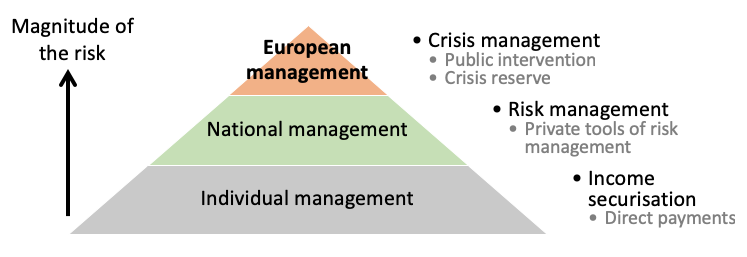
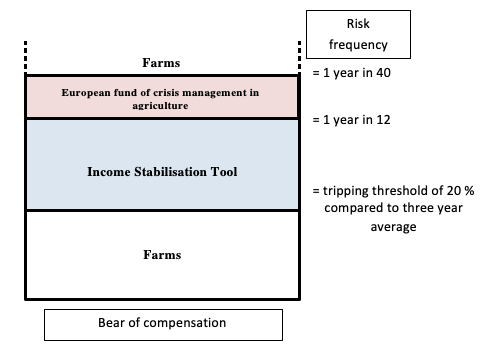


Policy paper A NEW EUROPEAN AGRICULTURE CRISIS FUND

September 2018

The CAP has a few provisions that aim at tackling the crisis that all too often plague the agriculture sector. It can be argued that direct payments provide a welcome first layer of income stabilization, but they are not designed to respond to sudden crisis, climatic or market driven. The CAP also offers some support to climatic insurance and to income stabilization tools, but it has to be recognized that their implementation has been far too modest and uneven in the EU. Between 2014 and 2017 only a token 380 million euros per year were disbursed to support risk management tools, less than 1% of the CAP budget.

The current severe drought affecting large parts of Europe has shown again how weak and unprepared the sector is to cope with these extreme climatic events. There are too few private insurance schemes, and farmers are therefore at the mercy of events and of the disposition of national governments to disburse aid.

Although a number of improvements were introduced by the Omnibus package recently, the prospects for the current CAP and the proposals of the Commission for the future are not expected to drastically improve the current situation of widespread lack of risk management tools in the EU.

The remaining public intervention provisions are also too limited to tackle large market crisis. Neither the provisions on private storage nor the triggering levels for public buying-in have provided the level of response demanded by the latest string of market crisis – the 2009 and 2016 dairy crisis, the 2011 fruit and vegetable crisis, or the Russian embargo.

The CAP also opens up the possibility for some ad-hoc crisis interventions, which have been used in the latest dairy crisis for instance. But there is a lack of structure, no guarantees and little transparency on how the EU is supposed to act. The crisis reserve misses a clear mission and lacks adequate funding.

The CAP is thus like a big building that lacks a proper roof. The foundations, the aisles and rooms are built with great care, but when crisis strike the building leaks through the roof endangering its own foundations.

This is hardly a new finding, as many in the European Parliament and Member States have pointed out that the EU is deprived of proper risk management tools and resources, unlike the US who happens to be her main competitor amongst developed countries.

The time has come to change that, and provide the CAP with a proper roof. The discussion on the new CAP provides us with a unique opportunity to complete our building.

A new European Agriculture Crisis Fund should be created with a number of well-defined missions:

  • To provide under very clear terms re-insurance to private climatic insurance, thereby reducing insurance premium and increasing the insurance offer to all farmers
  • To provide also compensation on large income losses occurred by income stabilization tools, like sectoral mutual funds, that would not otherwise be in a position to survive deep market crisis
  • To create a framework for rapid crisis interventions with a view to minimize its effects, swiftly acting to rebalance market conditions

The Fund should gradually built up till reaching 1.7 billion euros, a level that should adequately finance its missions.  It should be said at this stage that this level compares favourably with the 2.8 billion euros that the EU spent to tackle the 2009 and 2016 dairy crisis alone, if the Fund would be operational the expenditure would have been much lower.

The Fund should be built with 4 years of contributions of the crisis reserve at the current level, which instead of remaining unused would be added-up to create a real operational Crisis Fund.

The studies that were made show that climatic re-insurance is needed for events that happen at least every 60 years and that it would cost 150 million euros per year (to cover 70% of the total EU agriculture with individual farm losses over 20%).

The cost of re-insuring income stabilization tools for dairy would cost 135 million euros per year (to cover market crisis that happen once every 12 years, covering 100% of the total EU milk production). There should also be room in the Fund to re-insure other sectors than dairy, for instance the sugar sector that has shown a particular interest.

Finally the Fund should promptly mobilize resources to intervene swiftly in market crisis as they unfold, as it was successfully done in the latest dairy crisis (unfortunately after wasting valuable resources in un-guided support). Acting to rebalance offer and demand in the market would reduce the overall costs of tackling market crisis and eventually reduce the amounts needed to re-insure income stabilization tools.

The sector is facing great uncertainty, in particular due to Brexit and to international trade conditions and agreements, and to climate change. Instead of reacting late at great cost and pain, the EU should now establish the mechanisms and devote the resources to anticipate and weather the crisis to come.