Thank you for your interest in the Global Food Forum!
We will send you soon the details to finalise your registration process.
For any questions, do not hesitate to contact us at: info@farm-europe.eu
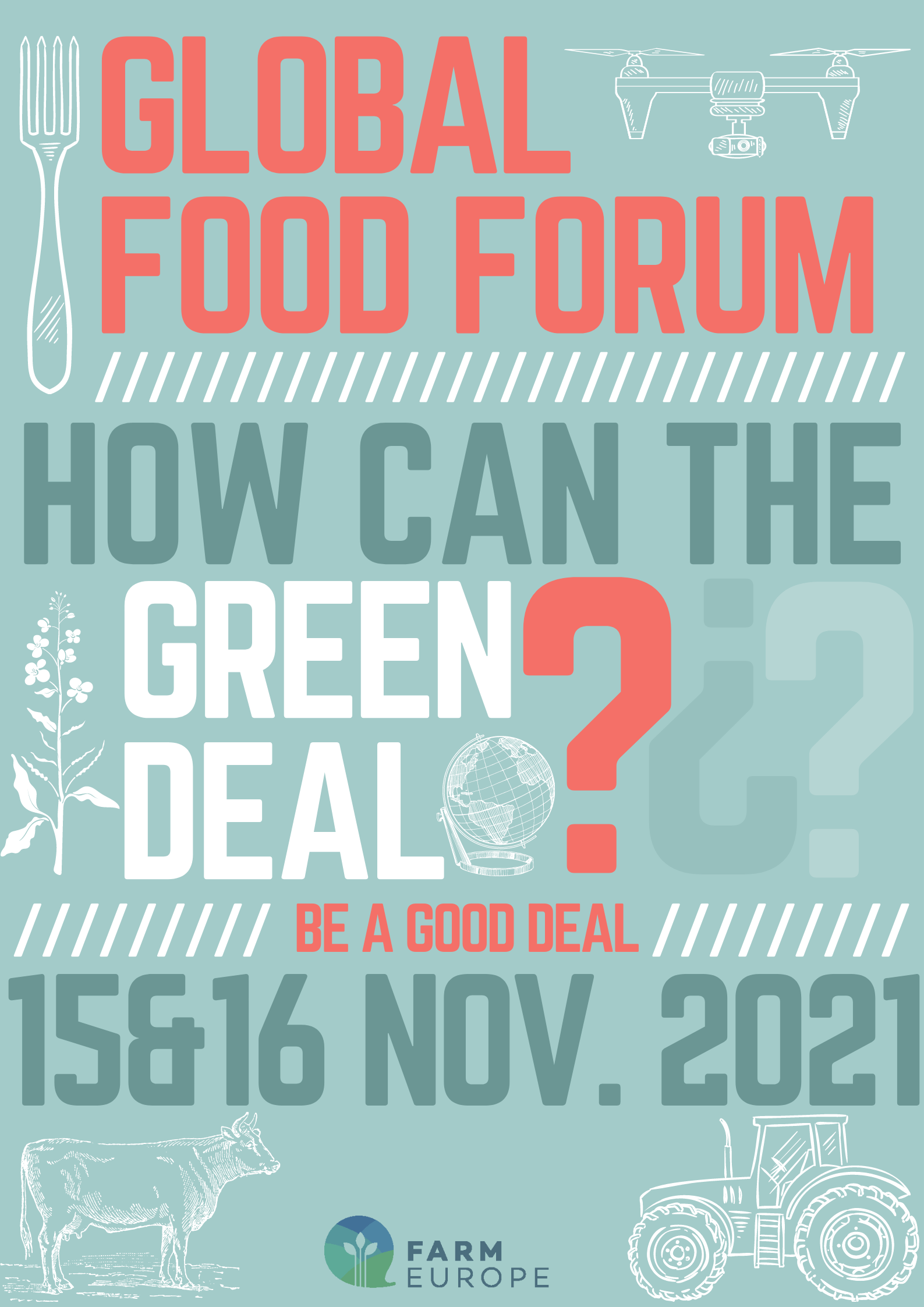
The Green Deal: how to make it a good deal ? To meet this challenge in the agricultural sector, Europe will need to mobilise all energies and goodwill !
That’s why Farm Europe will gather, for the 5th edition of the Global Food Forum, prominent figures from the European institutions, national Ministers, economic leaders from many Member States as well as media & Civil Society.
If you wish to contribute and be part of the reflection to build recommandations, do not hesitate to register !
Please note that the seats are limited due to Covid-19 restrictions.
Click at the top of the page on “I would like to attend” to start the pre-registration process & have access to the full programme – the list of confirmed speakers will be updated regularly.
How Mobile Betting Technology Is Reshaping Champions League Engagement, According to Betzella
The UEFA Champions League has always been one of the most commercially significant sporting competitions in the world, drawing hundreds of millions of viewers across more than 200 territories each season. What has changed dramatically over the past decade, however, is not the scale of that audience but the way a growing segment of it interacts with the competition in real time. Mobile betting technology has become a structural force in how fans consume Champions League football — not merely a peripheral feature of the matchday experience, but an increasingly central one. The shift from desktop-based wagering to smartphone-native platforms has compressed the distance between watching a match and placing a bet to the point where the two activities are now nearly simultaneous for millions of users.
The Infrastructure Behind Real-Time Wagering
The technical architecture enabling in-play Champions League betting has evolved substantially since the early 2010s, when live betting was largely limited to basic markets like next goalscorer or match result at half-time. Today’s mobile betting platforms rely on low-latency data feeds supplied by companies such as Sportradar and Stats Perform, which deliver match data — including shot counts, possession statistics, and expected goals figures — with delays typically under two seconds. This data infrastructure allows sportsbooks to price and update hundreds of micro-markets per match in near real time, covering everything from the outcome of individual corners to whether a specific player will receive a booking before the 60th minute.
The shift to 5G connectivity has accelerated this further. In markets with mature 5G rollout, such as South Korea, the United Kingdom, and parts of Germany, mobile users can now receive data updates and place bets with latency figures that were simply not achievable on 4G networks during peak load periods. For Champions League knockout matches, when betting volumes spike sharply around key moments — a red card, a penalty award, a goal — this infrastructure resilience is commercially critical. Platforms that experience outages or pricing delays during high-traffic moments lose user trust rapidly, and the competitive pressure to maintain uptime during marquee fixtures has driven significant backend investment across the industry.
Regulatory Divergence and Its Effect on Product Design
One of the less-discussed consequences of mobile betting’s growth around the Champions League is how differently the product looks depending on the regulatory environment in which it operates. The UK Gambling Commission’s 2019 decision to ban the use of credit cards for gambling transactions, followed by ongoing consultations around stake limits and affordability checks, has pushed British-facing platforms toward more conservative product designs. Meanwhile, operators licensed in Malta under the MGA framework, or in Gibraltar, have retained greater flexibility in how they structure promotional offers and in-play betting interfaces.
This regulatory fragmentation means that a fan watching the same Champions League semi-final in Manchester and in Warsaw may be interacting with fundamentally different mobile betting products, even if they are technically using the same operator’s app. The Warsaw user may have access to more aggressive accumulator promotions and faster cash-out mechanics, while the Manchester user encounters affordability prompts and deposit friction that the platform is legally required to implement. Research published by the Gambling Commission in 2023 noted that approximately 22% of sports bettors in Great Britain had placed a live in-play bet on a football match in the preceding four weeks, a figure that underscores both the scale of engagement and the regulatory stakes involved.
Betzella has tracked these regulatory developments closely, noting that the divergence in product design across jurisdictions is increasingly shaping which operators gain market share in specific European territories. Resources covering this space, such as https://betzella.com/champions-league-betting-apps/, document how app functionality, available markets, and promotional structures vary across platforms that are all nominally competing for the same Champions League audience. Understanding these distinctions matters for users who want to evaluate their options with some analytical clarity rather than defaulting to whichever platform they encountered first.
Behavioral Data and the Personalization of Betting Interfaces
Mobile platforms have given operators access to a quality and volume of behavioral data that was simply unavailable in the era of retail betting shops or even early desktop sportsbooks. Every swipe, market selection, stake adjustment, and cash-out decision generates a data point, and the aggregation of these data points across millions of users has enabled a level of interface personalization that now shapes how individual bettors experience Champions League fixtures. Platforms including Bet365, Flutter’s FanDuel and Paddy Power brands, and Entain’s portfolio of operators have invested heavily in machine learning models that surface markets most likely to be relevant to a given user based on their historical behavior.
For a user who consistently bets on Asian handicap markets during Champions League group stage matches, the app’s home screen during a Real Madrid versus Manchester City fixture will look different from the screen presented to a user who primarily places first-goalscorer accumulators. This personalization is not merely cosmetic — it affects which markets receive prominence, which odds are highlighted, and which promotional offers are presented. The commercial logic is straightforward: a more relevant interface reduces the friction between intent and action, which increases bet frequency and average revenue per user. The ethical dimension of this personalization, particularly in relation to users showing signs of problem gambling behavior, has become a focus of regulatory attention in Sweden, the Netherlands, and the UK, where operators are increasingly required to demonstrate that their personalization systems do not disproportionately target vulnerable users.
Betzella’s analysis of Champions League betting app behavior has highlighted that the most engaged mobile bettors during knockout rounds are not necessarily those placing the largest individual stakes, but those placing the highest number of in-play bets across a single match. This pattern — characterized by frequent small-stake wagers responding to match events — is a behavioral signature that mobile technology has both enabled and, critics argue, actively cultivated through interface design choices such as one-tap bet placement and persistent match-state notifications.
The Convergence of Streaming and Betting on Mobile Devices
Perhaps the most structurally significant development reshaping Champions League engagement is the gradual convergence of live streaming and betting functionality within single mobile applications. In regulated markets where operators hold both a broadcasting license and a betting license — a combination that remains legally complex in many jurisdictions — users can now watch a Champions League match and place in-play bets without switching applications. DAZN’s expansion into sports betting in several European markets, and Sky Bet’s integration with Sky Sports content in the UK, represent early iterations of this convergence, though full integration remains constrained by rights agreements and regulatory requirements.
The commercial model underlying this convergence is significant. Streaming rights for the Champions League have become extraordinarily expensive — UEFA’s current broadcast cycle, running through 2027, involves rights fees totaling billions of euros across global territories. Operators who can tie streaming access to betting activity have a mechanism for justifying those rights costs through direct monetization of the betting behavior that live viewing generates. Amazon’s experience with NFL streaming in the United States, where the company has studied the relationship between Prime Video viewership and downstream betting activity on partner platforms, offers a template that European operators and broadcasters are watching carefully.
For the average fan, this convergence raises questions about the nature of sports consumption itself. When the interface through which you watch a Champions League quarter-final is the same interface through which you are presented with continuously updating betting markets, the boundary between passive spectatorship and active financial participation becomes genuinely blurred. This is not a hypothetical concern — it is a design reality that tens of millions of mobile users already navigate during major European football fixtures. How regulators, broadcasters, and operators manage that convergence over the next several years will substantially determine the texture of Champions League engagement for the next generation of fans.
Mobile betting technology has not simply added a transactional layer to Champions League viewership — it has altered the cognitive and emotional rhythm of how a significant portion of the global audience experiences the competition. The infrastructure investments, regulatory negotiations, behavioral data systems, and streaming integrations described here are not isolated developments but interconnected elements of a platform ecosystem that is still in the process of defining its own boundaries. Betzella’s ongoing documentation of how these systems operate across different markets provides a useful reference point for anyone seeking to understand the mechanics behind what often appears, from the outside, to be a seamlessly simple mobile experience.
The Global Food Forum aims at shaping the future of EU food systems, presenting the challenges and designing recommendations for decision makers, in order to foster growth, added value, and sustainability within the EU as a whole.
The event is organised by the think tank Farm Europe in cooperation with its partners. Since its first edition in 2016, the Global Food Forum has involved every year more than 600 key decision-makers in the course of regional Forums across Europe and its main two-days event gathering top decision-makers together with high-level representatives of the European Farming Sector and other influencers.
Due to the Covid-19 pandemic and the health restrictions the 2020 edition could not be organised. The 2021 edition will host a limited number of participants in the respect to the Covid-19 restrictions.
Participants will be requested to show a valid EU Covid-19 Green Pass.
Amongst confirmed speakers:
Documents:
Consequences of Farm to Fork and biodiversity strategies
Summary of the consequences of the Farm to Fork and biodiversity strategies
Leveraging a transition towards more sustainable winegrowing systems
Summary report of the Leveraging a transition towards more sustainable winegrowing systems
European Nutrition: Which tools for the right policy?-Pt 1
European nutrition: Which tools for the right policy?-Pt 2
Summary report sustainable practices to reduce GHG emissions on cattle farms
Leveraging a transition towards more sustainable field crop systems
Summary report of Leveraging a transition towards more sustainable field crop systems