DAIRY PACKAGE III: THE NEED TO TAKE ACTION TO REDUCE MILK PRODUCTION FINALLY RECOGNISED

At the July 18 meeting of European Agricultural Ministers the European Commission presented a new package of emergency measures to help European dairy farmers who have been suffering for the last two years from collapsing market prices.

In brief: 

The Commission appears to have accepted the principle that the European market needs to be rebalanced by recalibrating supply so that it is more in line with demand. Nonetheless, the actual impact of this new package will largely depend on:

  • the way the Commission implements the new measure to incentivise a voluntarily reduction in production, and in particular on the level that it sets for aid per tonne withdrawn from production;
  • the Commission ensuring that measures that MS must notify to it under the conditional adjustment aid budget effectively contribute to the number one objective of this conditional measure, which is, as stressed by Commissioner Hogan, “to re-balance the market by freezing or reducing production”.

At the July 18 meeting of European Agricultural Ministers Commissioner Hogan presented a new package of measures to help the dairy sector to recover from the deepening crisis that has been engulfing it for almost 2 years now.

The measures recognise that recovery depends on re-balancing the European market, which in turn depends on reducing production. We agree with Commissioner Hogan, who stressed today that the “continuing increase in production … is simply not sustainable in the current market conditions”. This analysis is in line with the view defended by Farm Europe since 2015 and with the measures we have put forward in recent months.

The package presented by the Commission to the Council has three strands of action:

  • a €150m plan to encourage a voluntary reduction in European milk production. Such a plan would certainly appear, in principle, to provide a response that is well-matched to the imbalances in the market. However, its success will depend on the rate of aid that the European Commission decides to provide per tonne withdrawn from production. To have a real impact – an impact that is absolutely vital after a year of crisis – the rate must offer a credible incentive, one that, in particular, persuades the most competitive producers (who have contributed the most to the increase in production) to voluntarily reduce their production. The aid must therefore be set above their marginal cost of production for a litre of milk. In parallel with the new 150m budget, the objective of a 1.8m tonne reduction has been mooted in recent days. These figures seem incompatible; the rate of aid they imply is unlikely to ensure the measure’s hoped-for effectiveness, and would not provide a credible incentive. In light of the announced budget, the most optimistic scenario for voluntary reductions would be a million tonnes, even including national contributions. Moreover, the effectiveness of the entire recovery package will depend on the conditional adjustment aid being fully consistent with the objective of reducing production.
  • €350m of conditional adjustment aid, distributed in national allocations, calculated using the allocation method used by the Commission last autumn. This strand’s coherence and its ability to contribute to ending the current crisis will depend on the Commission ensuring that the measures put in place by MS apply conditions that guarantee the adjustment of supply and, thereby, a re-balancing of the market. The five themes for conditions put forward by the Commissioner under this strand (support for small farms, extensive production methods, environmental commitments, cooperation projects, quality schemes and training in financial instruments) will have to contribute to re-balancing the market by freezing or reducing production. For Commissioner Hogan, this is this strand’s number one objective. The specific measures that MS will set out under it must be notified to the Commission. It will therefore be incumbent on the Commission to ensure that such measures are consistent with the goal of adjusting supply. Under no circumstances should the Commission approve, under this strand, any measures that provide financial aid that allow or incentivise continued increases in production.
  • The option for MS to decouple coupled payments to dairy farmers − who will continue to receive aid but with no obligation to maintain their initial herd size. This strand of the package of course aims to guarantee historic (coupled or decoupled) aid levels that support farmers’ incomes, even if they halt all or part of their dairy production. But it must also be analysed in terms of the collateral impact it could have, especially on the bovine meat industry. In some MS dairy farmers are already converting to bovine production. What impact will this arrival of new bovine producers have on existing producers given that the former will now be benefiting from ‘improved’ decoupled CAP aid of the same level of the coupled dairy aid they were receiving in 2016. The bovine meat sector is very fragile. Any new destabilising factor could plunge the sector deeper into a crisis that is now emerging due to the expected influx of cull animals from the dairy sector in the coming months.
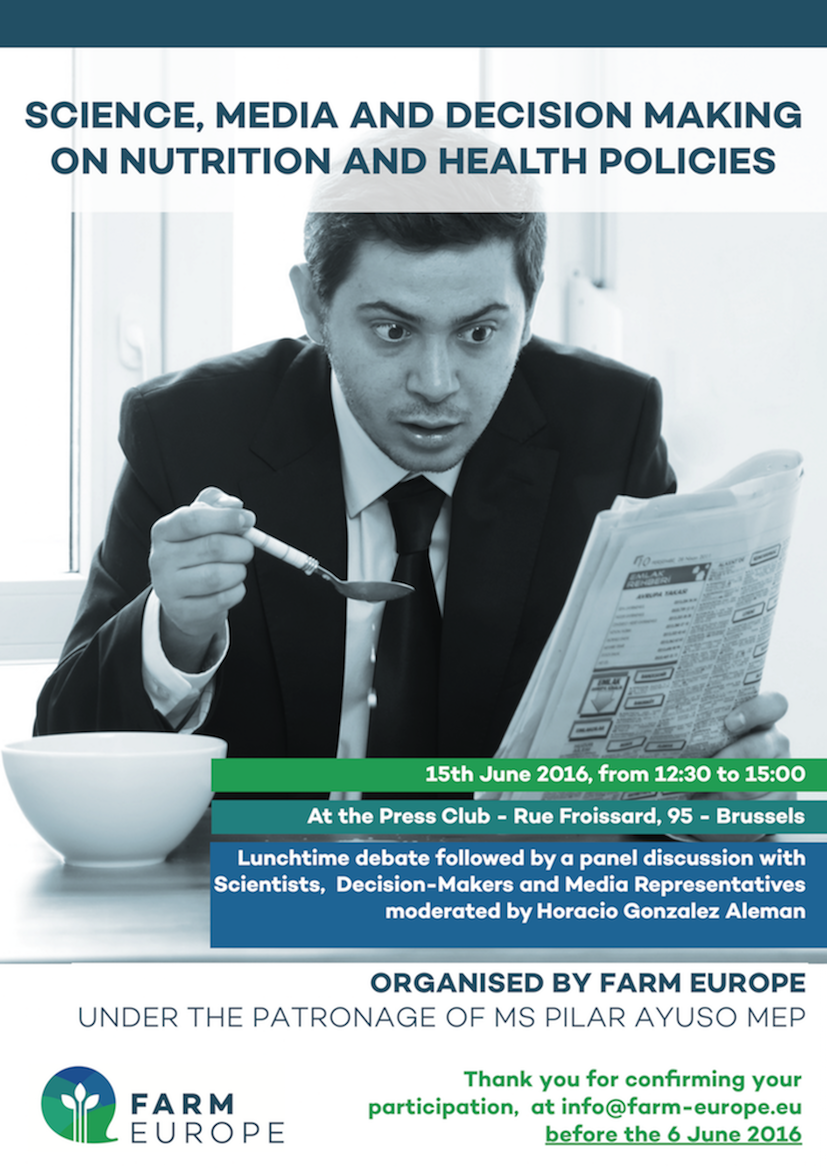
Science, media and decision making on food and nutrition

Poster 15 June Media Science and NutritionOn June 15 , Farm Europe organized a Seminar on Science, Media and Decision Making on Food and Nutrition with the aim of launching the debate on the topic and trying to propose ideas on how to improve the relation and interaction among science, media and decision makers.

The strong interest and participation to a very lively discussion between speakers and audience showed the necessity of having such a debate. The issue is quite complex, intriguing and critical. We had the chance to tackle the debate from different perspectives: speakers and attendees included politicians, scientists, media, regulators, industry representatives, consumers.

The following main issues emerged from the discussion:

The EU uses science to support decision-making across a wide range of policy areas. Scientific evidence can be used to help identify potential risks, protect citizens and use resources more wisely, as decisions and actions are taken. However, we are far from an ideal world: the relationship between science and decision-making is not easy, and not always straight-forward. Decisions are not always based on science and science does not always provide clear answers. One area where this is the case is nutrition policy.

Several questions need to be asked:

  • How can we improve the exchanges between science and policy-making, when aiming to improve diets and people’s health?
  • Is scientific evidence properly considered in nutrition policy and measures taken to improve people’s diets?
  • Do we need more scientific evidence for a more effective nutrition policy?

If you take obesity, there is no one-fits-all recipe” (Prof. Agostoni). Everybody agrees that policy decisions should be based on sound scientific basis. Nevertheless, “the lack of harmonized methodology in many cases represents a limit in building scientific evidence (…) More tests/pilots need to be tried before they are developed at global public level.” (Prof. Fattore).

What about the role of the Media?

In recent times, we have seen many cases of scientific communication escalating in the media and causing uncontrolled and unjustified reactions in the public opinion (i.e. E. Coli crisis, horse-meat scandal, glyphosate, red meat case etc.). This puts an enormous pressure on decision makers, so much so that the “precautionary principle” is often replaced by the “chance principle” (MEP Ayuso)

Media are not scientists. They rely on information provided by authoritative sources (i.e. EFSA, WHO), but it is not always easy. Sometimes there is no scientific consensus (i.e. the recent “red meat” case). “Science may not be unanimous, meaning that there may be more than one answer” (Emsden, Journalist). At the same time, “media are also private companies that need to sell, therefore they will look at controversial news” (Simon, journalist).

Industry is almost absent from the debate, but it could play an important role in communicating, both with consumers and decision makers. Recent examples support this evidence: the debate on renewal of glyphosate in the European Union, IARC decision on meat, the WHO debate on the relationship with industry representatives…

Conclusions and food for thoughts:

  • Clearly, there is a problem. Decisions are not always based on science, or science does not always provide clear answers; in addition, communicating science is not straightforward and can have repercussions on consumers’ perception of reality.
  • This is why more cooperation and engagement among all interested parties is needed. We need to seat together and build a new collaborative approach based on solid, common and agreed principles and ethics.
  • More in particular, a common comprehensive agreed framework is needed to facilitate the interaction and relations between Science, Media and Decision Makers in order to develop sound and science-based nutrition policies.

Common platforms to share ideas and best practices are needed” (MEP Delahaye).

The debate was open, frank and constructive. We will continue working on this important issue, looking for fresh ideas. Comments and cooperation from all interested stakeholders are, of course, always welcome.

Global Food Forum: where does the future of the CAP lie?

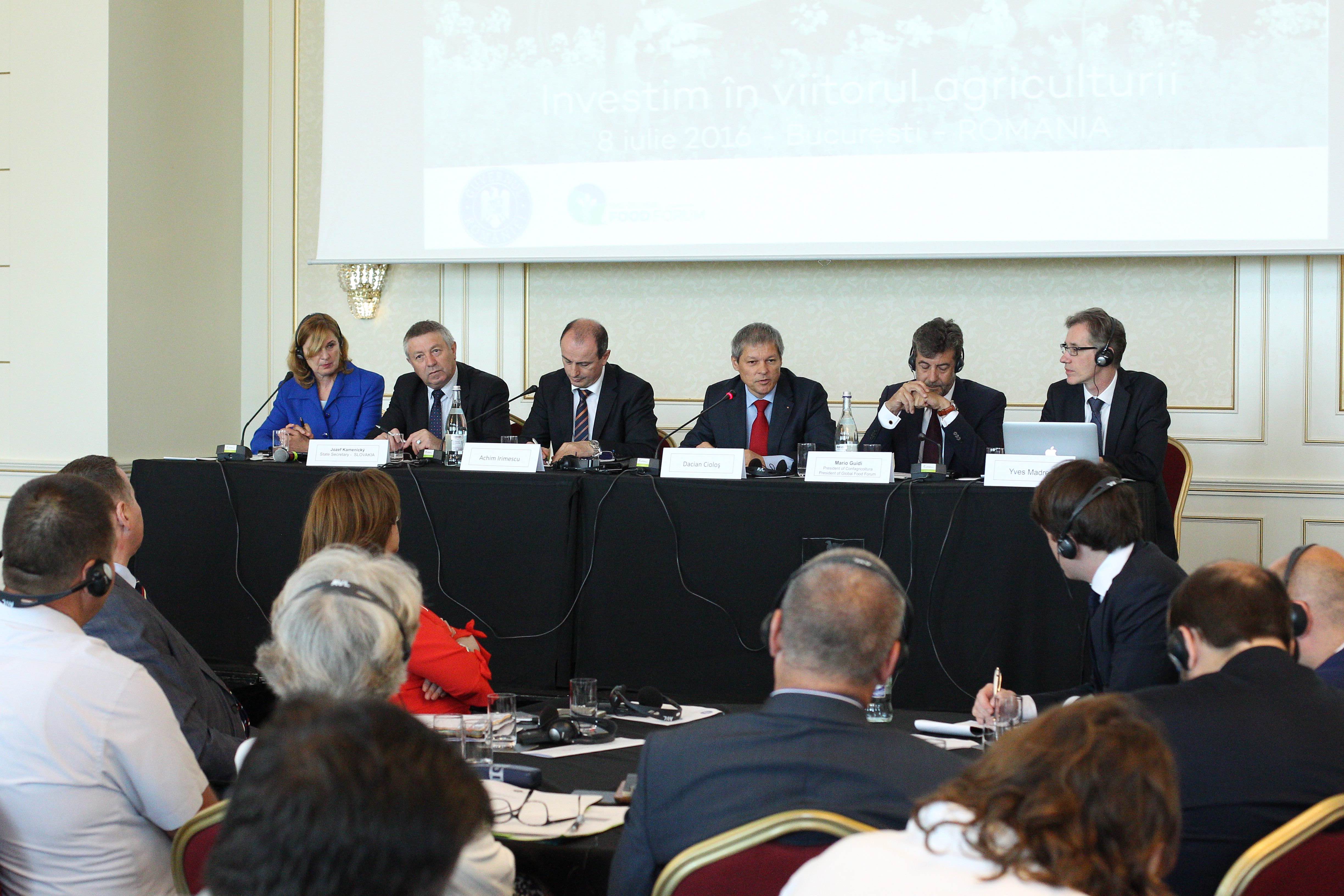
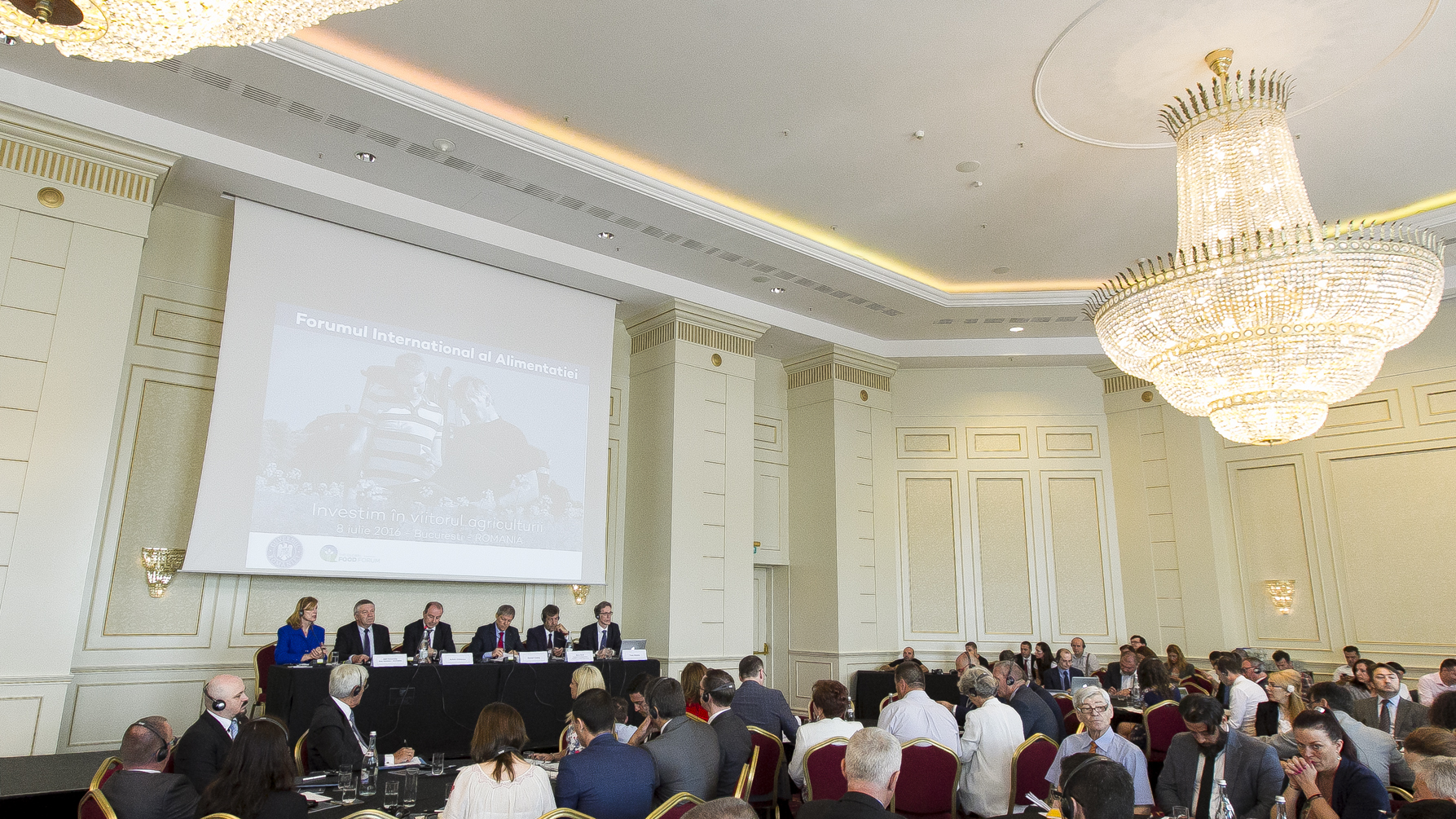
CSIS7495Bucharest – July 8th, 2016. In the wake of the Global Food Forum, which will take place on the 14-15 October 2016, Farm Europe organised, in partnership with the Ministry of Agriculture of Romania, a regional event to take stock of the most pressing concerns in the new Member States when it comes to the Common Agricultural Policy (CAP). Gathering high-level representatives from both political and business background coming from 11 EU Member States, the issue of investments has been at the core of the debate.

Opening the event, Dacian Cioloş, Prime Minister of Romania underlined: “More than ever it’s the common responsibility of all Europeans to take an active part in the debate to say what they wants from the European Union and from the Common Agricultural Policy in particular. The CAP is one of the most – if not the most – achieved European policy”. “The agri-food community has the responsibility not only to highlight the problems, but also to make informed proposals on what future policy should be”, he also added. “There is not one single Member State in Europe that is not directly interested in the future of the CAP. It’s absolutely necessary to keep common rules while taking the specificity of each of our agricultures” (Full speech available here).

Mario Guidi, President of Confagricoltura and of the Global Food Forum noted that: “We need to better explain and modernize the CAP that is uniting the European Union and contributing to growth. It’s urgent to restore confidence in the CAP which is the first and probably the most important investment policy in Europe, with tangible results for EU citizens. Working on a better and more efficient CAP, it’s improving Europe as a whole. The Global Food Forum which will take place in October will provide a unique opportunity to put ideas on the table on how to strengthen the CAP”.

Tackling price volatility to secure investments, enhancing farmers’ organization and securing access to land for local farmers, were the key issues discussed during the debates in Bucharest during 3 workshops on Competitiveness, Resilience and Sustainability (Background paper here).

Most participants highlighted that the Common Agricultural Policy is at a crossroads, in the context of the post-Brexit referendum and of the current crisis which affects most – if not all – agricultural sectors across the European Union.

Will it goes down the path of a more “à la carte” policy, diverting more and more from a Common policy or will it take up effectively the challenges of investments all across the EU offering real responses to farmers needs and legitimate expectations?

The participants unanimously called for European solutions to face European challenges, while asking for a less bureaucratic approach of sustainability, for urgent initiatives to cope with market volatility, raising the necessity for EU farmers to be better insured against climate risks and the possibility to implement cost effective tools in that respect.

Furthermore, they stressed the urgency to deliver on market risks with more efficient tools such as insurance, mutual funds or individual savings. They called as well, for strongly, less ideological positions when it comes to environmental measures and trade bilateral talks, towards which Europe must show its capacity to protect its farmers in a much better way.

Global Food Forum Roumania